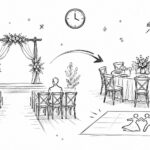
A venue may advertise space for 300 guests, yet the room can feel crowded once you add the ceremony setup, dance floor, buffet, bar, band, accessibility routes, photographer access, and vendor staging. The useful question isn't merely whether 300 people can enter the building. It's whether 300 guests can dine, move, celebrate, and leave safely without forcing every service area into the seating plan.
This roundup compares seven venues for 300 guests in Central Texas, with options across the Austin to San Antonio corridor. The comparison focuses on stated capacity, indoor and outdoor ceremony choices, rental windows, included services, parking, accessibility, vendor restrictions, weather contingencies, and pricing transparency. Texas Old Town in Kyle receives dedicated attention because its four halls range from 150 to 320 guests, with Tejas accommodating up to 320 and Sage and Stone accommodating up to 300, according to the venue's event information.
Table of Contents
- 1. Texas Old Town
- 2. The Addison Grove
- 3. The Arlo
- 4. Pecan Springs Ranch
- 5. Canyonwood Ridge
- 6. The Milestone | Georgetown
- 7. The Witte Museum
- 7-Venue Comparison for 300 Guests
- Build a 300-Guest Venue Shortlist
1. Texas Old Town
Texas Old Town is the strongest flexibility play for a host who wants a large guest list without committing to a single oversized room. Its Hill Country campus in Kyle includes four private halls, Tejas for up to 320 guests, Sage and Stone for up to 300, and Redbud for up to 150, as described on the Texas Old Town venue page for 300 guests. That range matters because a 300-person wedding, quinceañera, corporate banquet, or milestone event may not need the same room configuration as a smaller celebration.
The campus also combines curated grounds, streams, water features, and indoor reception spaces. Hosts can plan an outdoor ceremony and move into a climate-controlled hall, or keep the ceremony indoors if heat or rain makes the original plan unsuitable. The four-hall model creates a less obvious advantage: the largest hall isn't automatically the best hall. Tejas may provide more breathing room for entertainment and circulation, while Sage or Stone may feel more proportionate when the guest count is close to 300 but the program is simpler.
The logistics package
Texas Old Town provides exclusive access from 8:00 a.m. to midnight, an on-site venue manager, clean-up, furniture breakdown, dressing suites, a prep kitchen, and a separate service entry. The venue also documents furniture counts and provides indoor and outdoor PA systems with Bluetooth connectivity and a wireless microphone. Those details help planners build a realistic floor plan instead of treating the advertised capacity as usable seating capacity.
Other practical provisions include a built-in beverage bar, large private parking, and an accessible layout. Hosts can bring any caterer, while the bring-your-own-beverage policy requires an approved bartending company. That arrangement offers menu and beverage flexibility, but it also means the host must coordinate drinks, bartending, insurance or approval requirements, and service timing.
Practical rule: Ask for the furniture inventory and a diagram showing the exact banquet layout, dance floor, bar, buffet, staging area, and accessible circulation before treating a 300-person capacity as confirmed.
Pricing is not published as a flat online rate, so you'll need to request availability and a proposal. The venue states that quoted pricing includes sales tax and gratuity and offers personalized payment plans. Its preferred-vendor list and multiple industry awards, including Hall of Fame recognition from 2013 through 2022, provide additional planning signals, though they don't replace a written quote.
Pros
- Capacity flexibility: Four private halls cover events from 150 to 320 guests on one campus.
- Weather resilience: Outdoor ceremony grounds can be paired with indoor, climate-controlled reception and ceremony spaces.
- Long access window: Exclusive access from morning through midnight allows more room for setup and breakdown.
- Vendor choice: Hosts can select their caterer and supply beverages under the venue's bartending requirements.
- Included operations: An on-site manager, clean-up, furniture breakdown, documented counts, parking, and sound equipment reduce coordination gaps.
Cons
- Inquiry-based pricing: Exact rental rates aren't posted publicly, so budget comparison starts with a request.
- Beverage coordination: Bring-your-own beverages still requires an approved bartending company and host-supplied drinks.
2. The Addison Grove
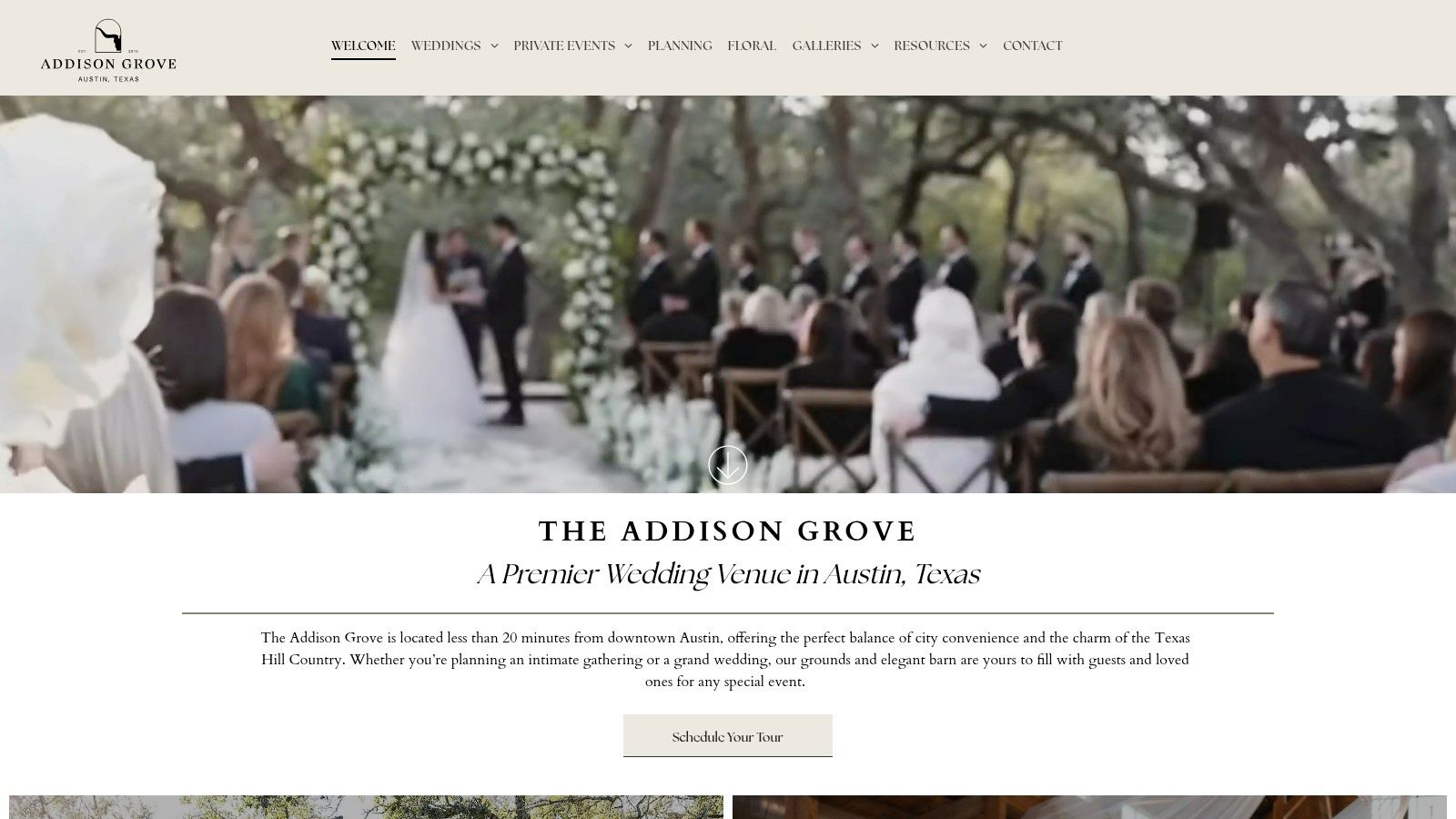
The Addison Grove suits planners who want a modern-rustic setting near Austin while keeping the room's capacity closely aligned with a 300-person reception. Its pecan-lined property is approximately 20 minutes from downtown Austin, and the barn seats up to 300 guests, according to The Addison Grove. That location can reduce the perceived distance for guests staying in Austin, although the final transportation plan still depends on lodging patterns and event timing.
The venue's indoor and outdoor flow is a central strength. Multiple ceremony sites provide visual choice, while an indoor ceremony backup protects the schedule when outdoor conditions change. A venue with a fallback inside the same property can prevent a last-minute room search, but planners should still ask whether the backup arrangement uses the reception room and creates a flip between ceremony and dinner.
What to verify before signing
The Addison Grove offers a 14-hour access window from 10:00 a.m. to midnight, along with tables and chairs, documented furniture counts, on-site parking, shuttle accommodation, an Event Safety Officer, and venue management support. Those inclusions make it easier to establish a timeline and check whether a proposed layout can hold dining, entertainment, and guest circulation.
The website doesn't publish a flat rate. Request a brochure or proposal that separates the rental charge from catering, staffing, rentals, security, taxes, gratuity, and overtime. The venue allows outside vendors, but house rules and restrictions should be confirmed in writing. A BYO-friendly policy may sound flexible until a caterer, bar team, décor company, or production vendor discovers a restriction that affects the schedule.
For a reception that uses the full barn capacity, ask for two diagrams rather than one. The first should show seated dining. The second should show the actual event program with a dance floor, buffet or plated service, bar, DJ or band, cake table, photographer access, and accessible routes. The difference between those diagrams reveals whether the room is comfortable or merely large enough on paper.
Best fit: Hosts who prioritize Austin proximity, a purpose-built barn setting, indoor ceremony fallback, and a long setup window, but who are comfortable requesting a detailed quote and confirming vendor rules.
3. The Arlo
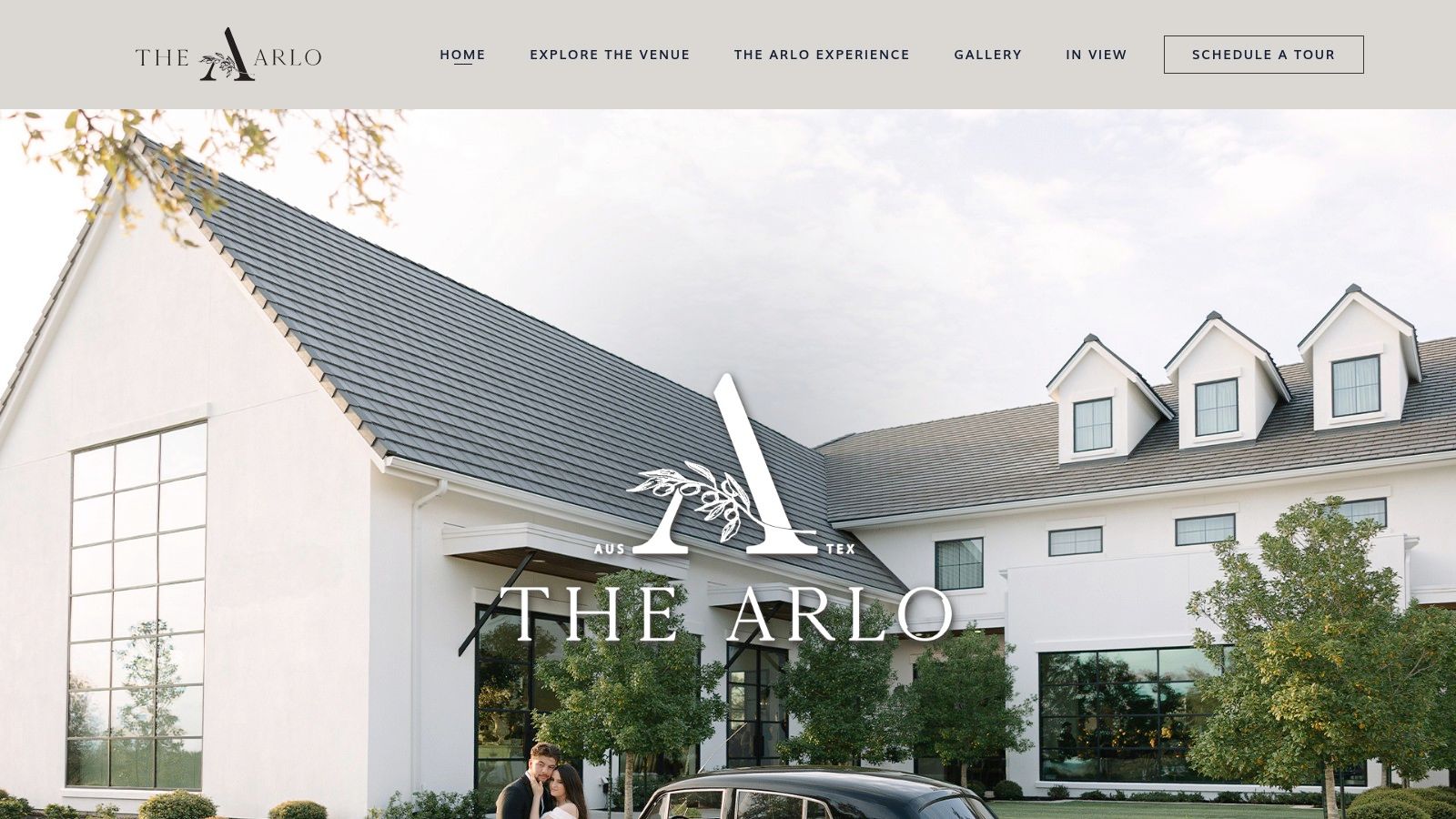
The Arlo takes a more purpose-built approach to large events. Located at Austin's southwest edge in Dripping Springs, the venue is a 15,000-square-foot event property with a 4,600-square-foot ballroom, a dedicated indoor ceremony room called Storie Hall, a deep covered veranda, and seating for up to 300 guests, based on The Arlo's venue details. Those spaces address a common weakness in outdoor-forward venues: the ceremony backup isn't merely a curtained corner or an improvised reception layout.
The covered veranda gives guests a transition zone between indoor and outdoor areas. It can support arrivals, photographs, or weather protection, but planners should ask how the space is used in the selected package and whether production equipment, cocktail service, or guest circulation competes for the same footprint.
Where the budget comparison is clearer
The Arlo publishes a rental range of $5,500 to $14,500, depending on the date. That makes initial budget screening easier than with venues that disclose no rate information, although the rental figure isn't the same as the total event cost. Catering, beverage service, planning, staffing, rentals, taxes, gratuity, and overtime still need separate confirmation in the proposal.
Tables, seating, and key spaces are included. The venue also supports shuttle and motor-coach parking, which is relevant for a Dripping Springs event where some guests may prefer not to drive after a formal reception. The trade-off is a more structured service model. A professional planner is required, and BYO alcohol is allowed only with TABC-certified bartenders arranged through the caterer.
Capacity is only useful when the venue can show where the service team, production crew, and mobility devices will move during the event.
The Arlo is a strong candidate for planners who value weather resilience and clearer rental-price visibility. It may be less suitable for a host seeking complete freedom over staffing or a highly informal vendor arrangement. Ask for a full-cost worksheet and a written explanation of planner, caterer, bartender, and service-staff requirements before comparing it with a simpler venue rental.
4. Pecan Springs Ranch
Pecan Springs Ranch offers approximately 300 guests indoors in a climate-controlled hall and can extend the event footprint through a covered pavilion and outdoor areas, according to Pecan Springs Ranch. The property is roughly 15 to 20 minutes from Austin, combining relatively close access with lawns, a pond, gardens, and multiple ceremony locations.
That combination is attractive for a garden-forward wedding or a corporate gathering that benefits from separate arrival, reception, and outdoor networking areas. It also creates a planning distinction that isn't obvious from the headline capacity. A 300-person indoor dinner may use the hall differently from a ceremony, cocktail hour, buffet, and dancing program spread across the property.
The outdoor-space trade-off
The venue provides a climate-controlled hall, covered pavilion, expansive lawns, and indoor and covered rain options. Those alternatives offer more than a simple “rain plan,” but each transition needs operational detail. Ask where guests go if rain arrives during the ceremony, whether the covered area can accommodate the planned seating, how vendors move food and equipment between spaces, and whether temporary flooring is needed on grass or uneven ground.
Exact furniture inventory and rate information aren't publicly listed, so the proposal should include both. The venue's outdoor elements also require seasonal planning for heat and cold. That includes shade, hydration, seating comfort, clothing expectations, sound placement, and a clear decision deadline for moving the ceremony.
For a host comparing large event venues in Central Texas, Pecan Springs Ranch belongs on the shortlist when scenery and layout flexibility matter more than a highly itemized public rate card. It may be less efficient for a planner who wants every furniture count and fee visible before making contact.
Best fit: Events that want a Hill Country garden atmosphere, multiple ceremony settings, and the option to distribute guest activity across a hall, pavilion, and grounds.
5. Canyonwood Ridge
Canyonwood Ridge is designed around a clear ceremony-to-reception sequence. The Dripping Springs venue includes a full indoor chapel, an adjacent reception hall, and an outdoor ceremony site with ridge-top views. Its 12,000-square-foot property is marketed for up to 300 guests, as outlined by Canyonwood Ridge.
The dedicated chapel is the key differentiator. It gives the event a defined indoor ceremony destination instead of requiring the reception hall to perform two jobs. That can reduce a room flip and make the timeline easier to communicate to guests, especially when the ceremony and reception need different seating or décor.
A venue for transition control
The adjacent hall supports a more direct movement from ceremony to reception. For 300 guests, that proximity matters because a large group can create bottlenecks at doors, bars, restrooms, and outdoor paths. During a tour, walk the route as a guest would. Check whether the path remains intuitive in low light, whether mobility-device users can take the same route, and where vendors can work without crossing through the guest experience.
Canyonwood Ridge doesn't publish pricing publicly, so a proposal is necessary for meaningful cost comparison. Ask whether the quoted rental includes tables, chairs, setup, teardown, ceremony seating, sound, staffing, and access to the chapel and reception hall. Also confirm the length of the rental window, because the venue's stated capacity doesn't indicate how much time vendors have for loading, installation, and breakdown.
Dripping Springs lodging and shuttle logistics should be arranged early for peak dates. That isn't a reason to exclude the venue, but it does make guest access part of the budget and schedule rather than a post-booking detail. A ridge-top setting may deliver strong scenery while requiring more deliberate transportation planning than a venue closer to central Austin.
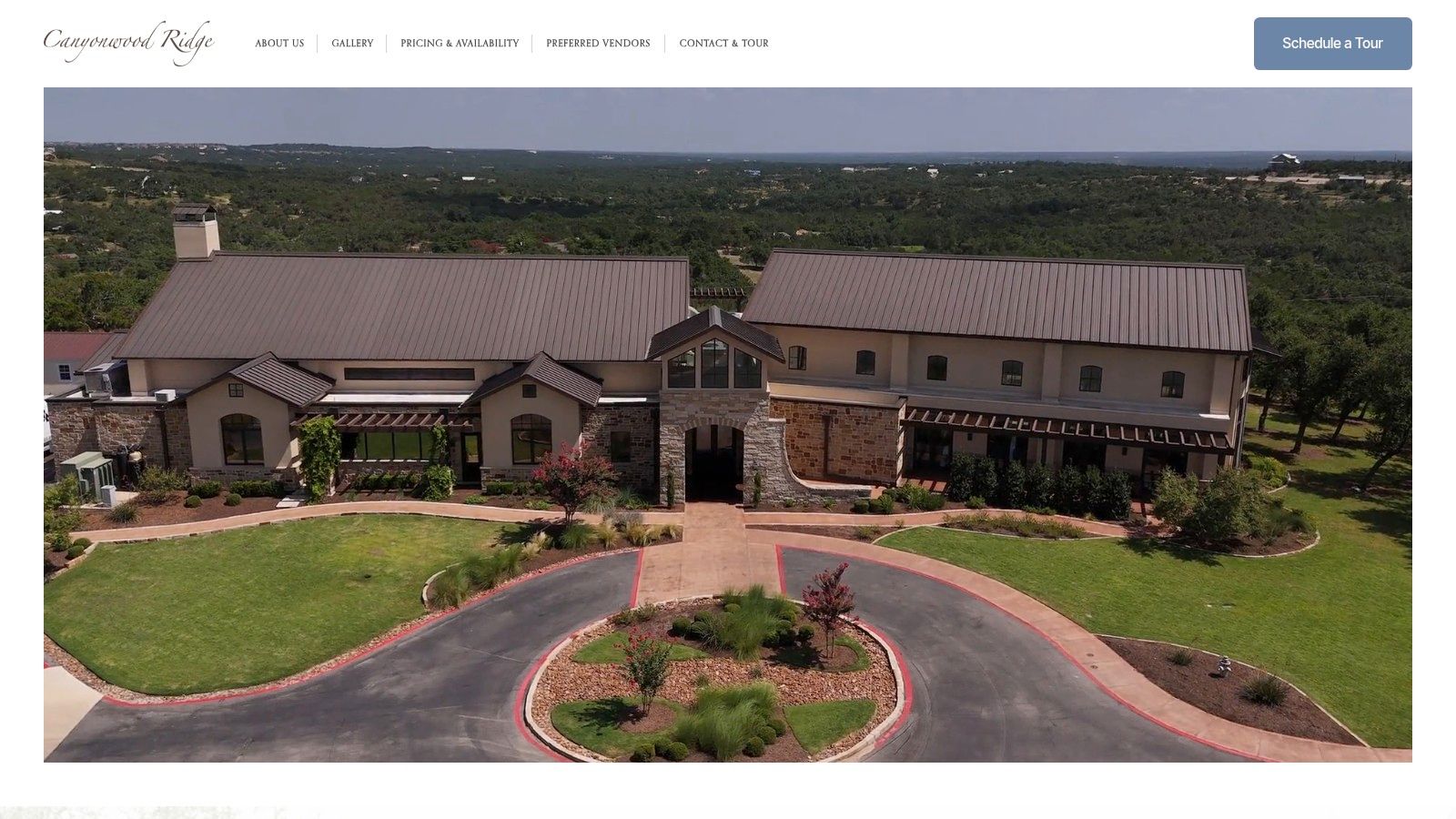
Best fit: Couples and event hosts who want a dedicated indoor chapel, a nearby reception hall, and a ceremony plan that remains workable when outdoor weather changes.
6. The Milestone | Georgetown
The Milestone in Georgetown offers indoor reception space for up to 300 guests on a 40-acre modern farmhouse property above the San Gabriel River, according to Walters Wedding Estates. Its strongest advantage isn't the capacity. It's the amount of package information available before the first proposal conversation.
The venue uses tiered, semi-inclusive packages with planning services, tables, chairs, linens, setup, and teardown included in the documented package structure. It also publishes starting venue fees and per-guest catering and beverage ranges. That level of pricing visibility lets a host decide whether the service model is plausible before investing time in a tour.
Transparent pricing with less vendor freedom
The Milestone provides in-house catering and beverage packages. That can simplify coordination because the venue and food-and-beverage team operate within one service model. It also limits choice. Hosts who already have a caterer, specialty bar concept, or independent production plan should confirm the restrictions before treating the venue as a candidate.
Vendor minimums can apply from Friday through Sunday. Ask how those minimums interact with the expected guest count, package tier, event date, and catering selection. A lower advertised starting fee may not represent the actual minimum for a popular weekend or a 300-person program.
The Georgetown location is north of Austin, so guests staying downtown may face a longer shuttle journey than they would at a venue closer to the city center. On the other hand, the property's single-site ceremony and reception arrangement can reduce venue-to-venue transportation and keep the event experience concentrated in one place.
Best fit: Planners who value published starting fees, documented inclusions, in-house food and beverage, and a more structured package over outside-vendor freedom.

7. The Witte Museum
The Witte Museum provides a different guest experience from a barn, ranch, or farmhouse venue. Its San Antonio riverfront campus includes exhibit settings, gardens, multiple rentable rooms, and museum-grade event spaces. Dawson Family Hall accommodates banquet events for up to 300 guests, while the Mays Family Center offers larger seasonal capacities, including up to 700 to 750 guests for a banquet and 1,000 for a reception from October 1 through April 30, according to the Witte Museum's venue information.
For a 300-person event, Dawson Family Hall is the more direct comparison. The larger Mays Family Center may be useful when the event needs substantial production, pre-function space, or a layout that goes beyond a standard seated dinner. A bigger room can improve circulation, but it can also make a smaller guest list feel less connected if furniture, lighting, and staging aren't carefully scaled.
Experience and policy considerations
The museum setting creates a distinctive arrival and reception environment, with exhibits and gardens contributing to the guest experience. It may also support more advanced audiovisual planning than a simple outdoor venue. Confirm the exact AV inventory, load-in route, power availability, noise rules, installation restrictions, and whether décor can be attached to walls or displayed near exhibits.
Seasonal availability matters, particularly for larger spaces. Museum policies and approved-vendor or catering requirements may also be stricter than those at a standalone private venue. Request the rules in writing, including insurance requirements, security, staffing, alcohol service, cleanup, and overtime.
For hosts comparing wedding venues near San Antonio, The Witte Museum is the distinctive-experience option. It makes the most sense when the setting itself is part of the event design, not merely a container for tables and chairs.
7-Venue Comparison for 300 Guests
| Venue | Setup & Logistics Complexity | Resource Requirements | Expected Outcomes (capacity & experience) | Ideal Use Cases | Key Advantages |
|---|---|---|---|---|---|
| Texas Old Town | Low, 16‑hour exclusive rental, on-site manager, included cleanup | Flexible vendors; BYOB with approved bartenders; documented furniture; ample parking | Scenic 55‑acre Hill Country campus, 4 private halls (150–320), photo-ready outdoor/indoor options | Weddings, quinceañeras, milestone celebrations, corporate events | Large campus, transparent quoted pricing (tax/gratuity included), preferred-vendor list, industry awards |
| The Addison Grove | Moderate, 14‑hour access window, documented furniture, Event Safety Officer | BYO vendors allowed with house rules; on-site parking/shuttle accommodation | Modern‑rustic barn up to 300, multiple ceremony sites with indoor backup, included tables/chairs | Rustic‑modern weddings near Austin | Included inventory and long access window; close to Austin lodging |
| The Arlo | Medium, exclusive 12‑hour rental, purpose-built for vendor flow, get‑ready suites | Requires professional planner; service‑staffing policies; BYO alcohol via TABC bartenders through caterer | 15,000 sq ft venue, 4,600 sq ft ballroom, weather‑resilient veranda, seats up to 300; published rental range | Large weddings needing clear capacity and logistics | Transparent pricing range; strong guest/shuttle logistics |
| Pecan Springs Ranch | Medium, climate‑controlled hall plus pavilion and lawns; outdoor planning needed | Furniture/inventory and rates require inquiry; plan for seasonal heat/cold | Garden‑forward grounds with pond and multiple ceremony spots; ~300 indoors, expandable outdoors | Garden weddings, flexible layouts, larger gatherings | Hill Country feel close to Austin; flexible indoor/outdoor spaces |
| Canyonwood Ridge | Medium, ridge‑top site with chapel and adjacent reception hall; designed flow | Pricing by proposal; arrange Dripping Springs lodging/shuttles for peak dates | Dedicated indoor chapel + reception hall, outdoor ridge views, capacity up to 300, streamlined transitions | Couples wanting chapel ceremonies with scenic views | Dedicated chapel backup; floor plan minimizes room flips |
| The Milestone | Low, semi‑inclusive packages with documented inclusions and on‑site suites | In‑house catering and beverage required; vendor minimums may apply on Fri–Sun | Modern farmhouse on 40 acres, up to 300, predictable budget with published starting fees | Couples preferring semi‑inclusive, package‑based planning | Published pricing and inclusions; in‑house catering simplifies coordination |
| The Witte Museum | Medium‑high, museum policies, seasonal availability for prime spaces | Approved vendors/caterers; stricter museum rules; strong AV and event staff requirements | Museum‑quality riverfront campus; Dawson Hall banquet up to 300; larger seasonal spaces available | Cultural or distinctive weddings, large receptions, corporate galas | Distinctive guest experience, strong AV, multiple rentable spaces and gardens |
Build a 300-Guest Venue Shortlist
The best venue depends on how the guest count behaves in the room. The Knot's Real Weddings Study reported an average of 117 wedding guests in 2025, based on a survey of roughly 10,000 U.S. couples, while the South and Southeast averaged 103 guests in 2024. A 300-person venue therefore sits well above ordinary wedding demand, which makes flexibility more valuable than a large capacity number alone. The same room must work for a full guest list, a smaller celebration, a cultural event, or a corporate banquet without making every event feel either cramped or empty. See The Knot's guest-list data for the broader attendance context.
Start by confirming usable seated capacity, not maximum occupancy. Ask each venue to show the planned arrangement with the dance floor, buffet or catering stations, bar, band or DJ, staging, cake table, photographer access, accessible routes, and guest circulation included. A 300-person room may be appropriate for plated dining but less comfortable for a program that adds a large dance floor, live entertainment, or multiple service stations.
Accessibility should be treated as part of operations and guest experience. Industry benchmarks cited by AMI Magazine's accessibility coverage report that 67% of event professionals consider accessibility very or extremely important to the future of events, while 82% of corporate planners prioritize it when selecting a venue. Request a dimensioned floor plan, step-free routes from parking to the event and restrooms, integrated accessible seating, restroom details, parking-to-door distances, signage information, and an evacuation plan that accounts for mobility, hearing, and visual needs.
Compare the quote, not the headline rate
Request a written quote that separates rental fees, taxes, gratuity, catering, beverage service, staffing, security, rentals, and overtime. Verify the exact access window, setup responsibilities, breakdown responsibilities, furniture counts, vendor rules, alcohol procedures, parking capacity, shuttle requirements, and indoor ceremony backup.
Pricing transparency varies across this list. The Arlo publishes a rental range, The Milestone publishes starting fees and per-guest ranges, and Texas Old Town provides quoted pricing that includes sales tax and gratuity while requiring direct inquiry for rates. Those models aren't directly interchangeable. A lower rental figure may exclude services that another venue includes, while a higher package may reduce separate vendor coordination.
Guest access deserves its own line in the comparison sheet. Planner data identifies higher event costs as the leading budget concern, followed by accommodation and transportation costs, while environmental priorities include recycling, reuse, local sourcing, food donation, public-transit access, and water conservation, as reported by ConventionSouth's industry report. For a Hill Country venue, ask about onsite parking, accessible routes, rideshare pickup, shuttle staging, nearby lodging, catering logistics, and waste practices rather than relying on a general claim of convenience.
Use Texas Old Town as a practical benchmark for long exclusive access, four capacity options, indoor and outdoor ceremony flexibility, included management and clean-up, documented furniture counts, transparent quoted pricing, and its Kyle position between Austin and San Antonio. Then create a comparison sheet and request tours or proposals from the two or three venues that best match your guest count, preferred geography, service model, and budget.
Texas Old Town combines four private halls, indoor and outdoor ceremony options, a 16-hour exclusive rental window, on-site management, included clean-up, flexible catering, and documented event logistics for celebrations of different sizes. Visit Texas Old Town to review the spaces, request availability, and compare a 300-guest plan with the hall and service model that fit your event.