You've found a beautiful wedding venue near Austin, TX, toured the ceremony lawn, pictured the tables dressed for dinner, and started comparing rental quotes. Then someone asks the question that changes the conversation: Who takes everything down after the last song?
At the end of a wedding, furniture breakdown affects more than the venue's appearance. It determines whether your caterer can leave on schedule, whether rented chairs and tables are returned correctly, and whether your family spends the final hour carrying equipment instead of saying goodbye. For Central Texas couples, post-event logistics deserve the same attention as ceremony views, climate control, and guest capacity.
Table of Contents
- Why Post-Event Logistics Matter for Your Celebration
- Understanding Furniture Breakdown Service Scope
- Texas Old Town Breakdown Inclusions and Timeline
- Evaluating Included Versus Third-Party Breakdown Options
- Coordinating Vendors for Seamless End-of-Night Flow
- Essential Planning Questions for Central Texas Venues
Why Post-Event Logistics Matter for Your Celebration
The final guests have left, the photographer is packing cameras, and the DJ is winding down. Tables still need clearing, chairs stacking, linens separating, and personal décor moving to the right vehicle. Without assigned staff, the couple's carefully planned celebration can end with an unpaid work shift for relatives.
For a wedding venue near Austin, TX, post-event logistics should carry the same weight as appearance and capacity. Furniture breakdown is a structured reversal of the room setup, completed after guests depart and coordinated with caterers, rental companies, bartenders, and family members collecting personal items. Routine trash removal does not cover that full sequence.

The last hour needs an owner
Without a designated team, each group may assume another party is handling the work. The caterer may focus on kitchen equipment, the rental company may wait for its inventory, and family members may not know which items belong to the venue. An exhausted couple then makes decisions that should have been settled before the wedding.
Practical rule: Ask who owns the room reset, who supervises it, and what “cleanup included” covers.
A written event logistics planning guide can help map transportation, vendor movement, guest departure, and handoffs between activities. The venue's event planning timeline should show when those responsibilities occur during the wedding day, including the period after the last guest leaves.
The right arrangement lets guests depart through a calm, finished environment while trained staff handle the physical work. It also gives vendors a clear loading process and keeps family members from spending the final hour carrying furniture, décor, or equipment.
Understanding Furniture Breakdown Service Scope
Furniture breakdown is the organized reversal of the room setup, completed after guests depart and coordinated with caterers, rental companies, bartenders, and family members collecting personal items. The work includes more than leaving the room tidy. Staff must restore the space in a controlled order while protecting rented inventory and meeting the venue's access requirements.
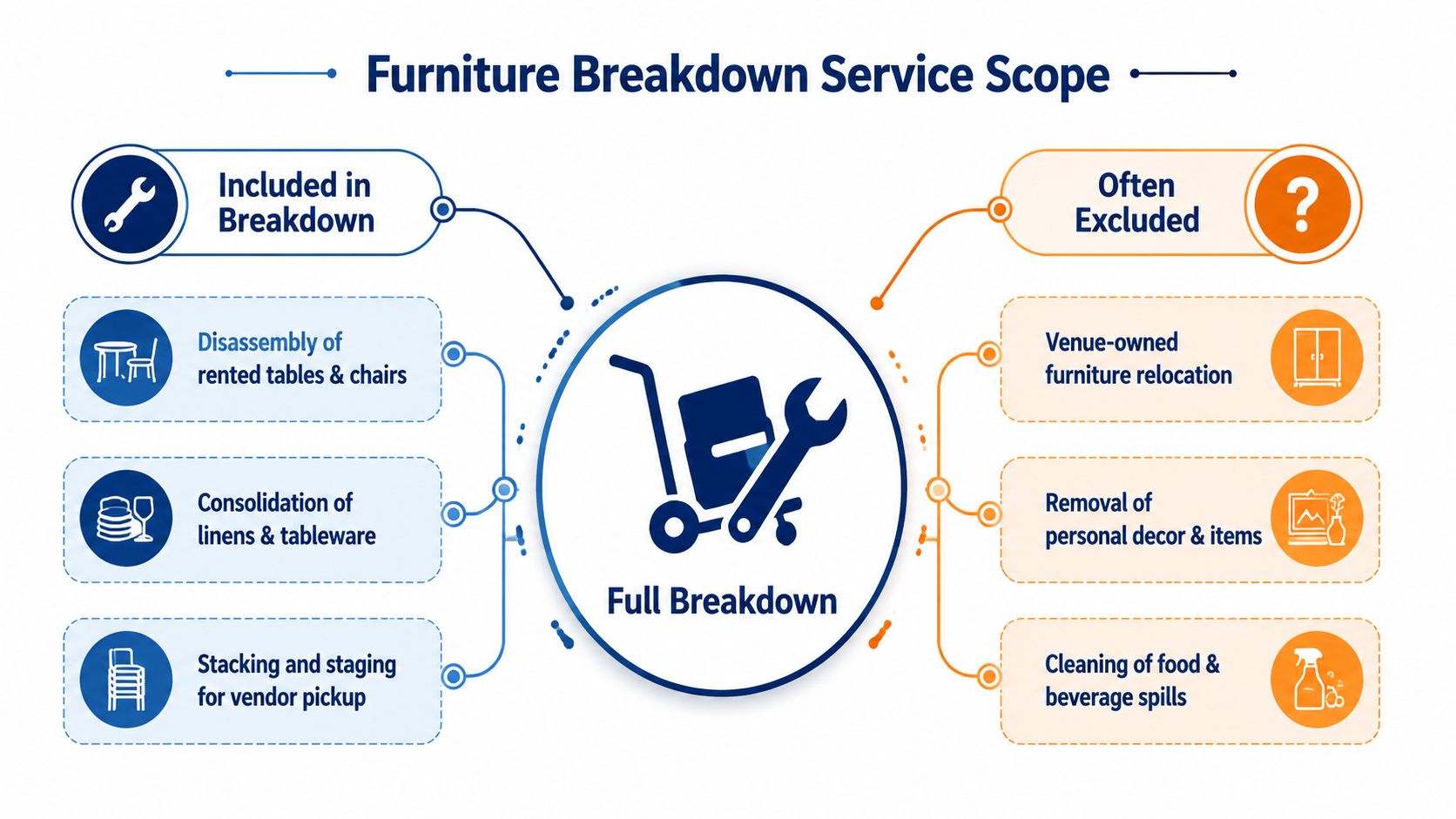
Basic cleaning usually covers waste removal, surface wiping, and leaving the room presentable. Breakdown adds physical labor and accountability. Staff may disassemble rented tables, stack chairs safely, separate linens and tableware, and stage each category for the appropriate vendor.
What the service usually covers
The contract should identify what happens to venue-owned items, rental inventory, catering equipment, and personal property. A useful scope discussion covers:
- Rented furniture: Tables and chairs are folded, disassembled where required, and grouped for pickup.
- Soft goods: Linens are gathered and kept separate from trash, food waste, and damp materials.
- Tabletop items: Plates, glassware, flatware, and serving pieces are consolidated according to the caterer's or rental company's process.
- Pickup staging: Items are placed in an agreed location that supports vendor loading without blocking guest routes or emergency access.
- Inventory awareness: Staff identify missing, damaged, or misplaced rental pieces before the final handoff.
Exclusions require equal attention. Venue-owned furniture relocation, personal décor removal, and food or beverage spill cleanup may require separate instructions, labor, or a different vendor. “Cleanup included” does not define who performs each task, when it occurs, or where items go.
Questions that prevent scope disputes
Ask whether venue staff handle the furniture, whether vendors remove their own equipment, and where personal belongings should be placed. Confirm whether breakdown occurs during the rental window, whether an on-site manager remains present, and whether the contract includes damage documentation.
The operational advantage goes beyond having staff present. It comes from a defined sequence: guests depart, vendors remove designated equipment, staff consolidate furniture and venue materials, and the manager confirms the room is reset before access closes. A clear answer should identify the responsible people, the handoff points, and the destination for each item after the last guest leaves.
Texas Old Town Breakdown Inclusions and Timeline
Texas Old Town's published model combines exclusive 16-hour access from 8:00 a.m. to midnight, on-site management, clean-up, and furniture breakdown. That structure matters because the event window has to accommodate vendor load-in, ceremony preparation, portraits, dinner, dancing, guest departure, and the post-event reset.
Industry guidance commonly places the actual need for wedding venue use at about 12 to 16 hours, particularly when setup and breakdown are included in the same operational window. All-day wedding rental guidance explains why longer access reduces schedule compression, especially when weather changes or vendor coordination adds pressure.
A practical room-reset sequence
At Texas Old Town, the selected venue is used exclusively during the rental period. That gives the on-site manager a defined environment to oversee, rather than requiring the couple to coordinate with unrelated events or shared-room users. The property includes four distinct halls, Tejas, Sage, Stone, and Redbud, alongside outdoor ceremony settings, so the exact furniture plan depends on the hall and the selected layout.
The published furniture counts support advance planning. Tejas accommodates up to 320 guests, Sage and Stone accommodate up to 300 guests, and Redbud accommodates up to 150 guests. Those capacities are venue-specific planning references, not substitutes for a conversation about your floor plan, ceremony layout, dance area, buffet, bar, and vendor stations.
| Service Component | Inclusion Detail |
|---|---|
| Rental access | Exclusive use from 8:00 a.m. to midnight |
| Venue management | An on-site venue manager oversees event operations |
| Furniture | Tables and chairs are provided according to the selected venue's published furniture counts |
| Post-event work | Clean-up and furniture breakdown are provided |
| Ceremony and reception | Outdoor ceremony options and an indoor, climate-controlled reception hall are available |
| Vendor workflow | A prep kitchen with a separate service entry supports catering logistics |
| Beverage service | A built-in beverage bar is available for host-provided beverages, with an approved bartending company required |
The operational advantage isn't just having staff present. It's having a defined sequence: guests depart, vendors remove their designated equipment, staff consolidate furniture and venue materials, and the manager confirms the space is reset before the access period closes.
Evaluating Included Versus Third-Party Breakdown Options
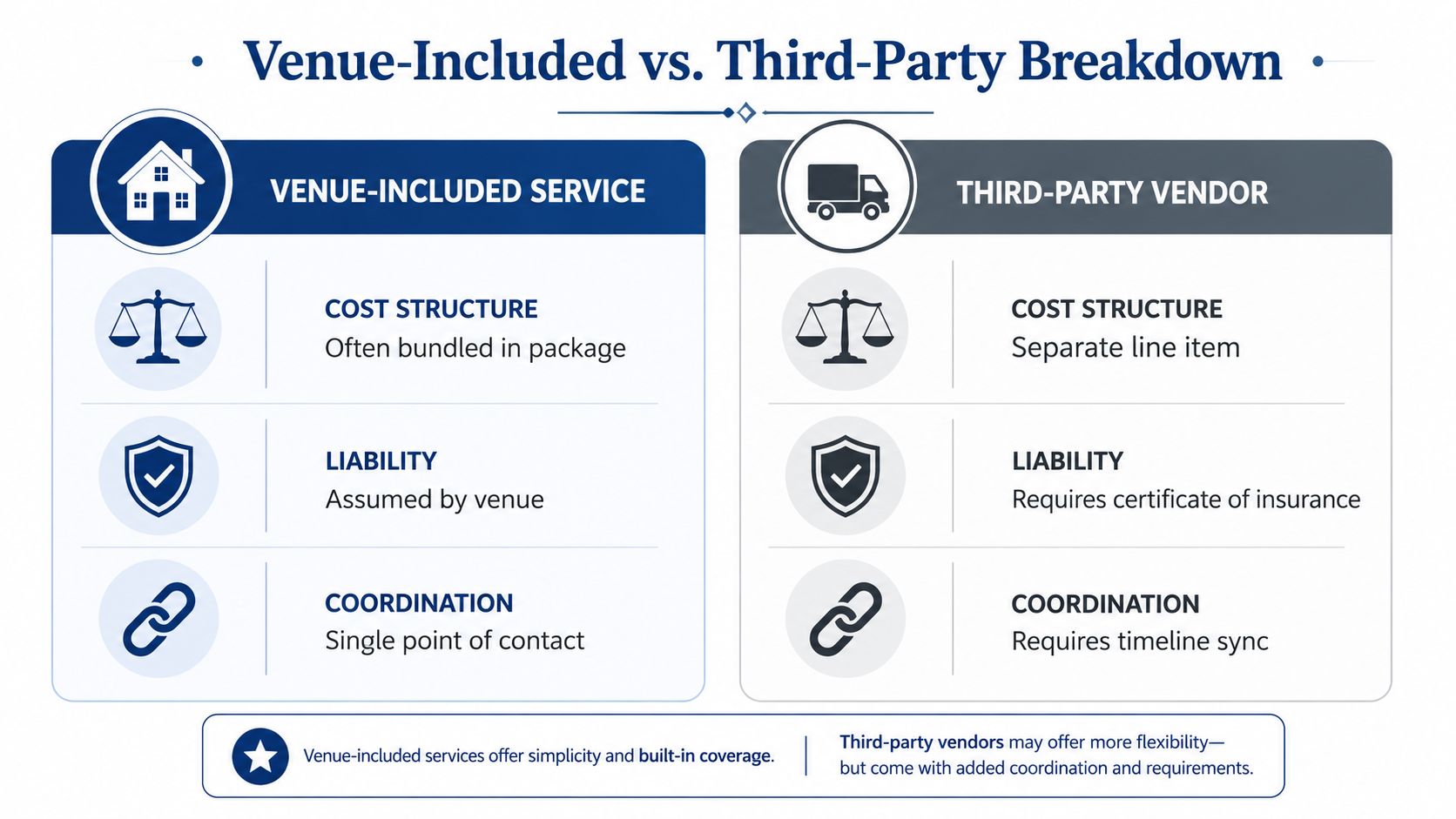
A venue-included breakdown service and a third-party labor crew can both work. The difference lies in who carries responsibility for timing, access, damage, and communication. That responsibility affects the final hour of the reception, when guests, vendors, and venue staff are sharing the same exits and loading areas.
With venue-included service, staff already knows the building, loading routes, storage areas, furniture, and closing procedures. A third-party crew may give you more control over labor selection, but you must confirm arrival times, insurance requirements, access instructions, equipment, and who can make decisions on-site.
Compare the complete operating model
Austin venue pricing varies by package structure. Venue-only rentals have a median around $8,900, while all-inclusive packages can have a median around $22,275, according to Austin wedding venue pricing data. These models cover different obligations, so comparing only the base rental fee can hide labor, catering, bar, furniture, and cleanup costs.
| Decision factor | Venue-included breakdown | Third-party or DIY breakdown |
|---|---|---|
| Cost structure | Often bundled into the venue package | Usually a separate labor line item |
| Accountability | Venue team manages its own process | Couple or planner coordinates the vendor |
| Familiarity | Staff knows the property and furniture | Crew needs site-specific instructions |
| Liability | Governed by the venue's contract and policies | May require insurance documentation and separate terms |
| Timing | Aligned with venue closing procedures | Depends on crew arrival and vendor handoffs |
| Personal items | Often still the couple's responsibility | Usually still the couple's responsibility unless contracted |
DIY breakdown can appear inexpensive until family members lift heavy furniture, vendors wait for access, or a rental company reports missing pieces. Tired guests moving equipment through parking areas or uneven outdoor routes also create avoidable safety and damage concerns.
A third-party crew fits venues that exclude breakdown, décor installations with unusual labor demands, or planners with an established team. If the venue already includes the service, verify its scope before paying for overlapping labor. Confirm whether the package covers furniture only, who removes décor and personal items, and when the space must be cleared.
Couples who want a separate day-of point person should define that role through day-of wedding coordination before signing contracts. A written division of duties prevents the venue team, planner, and labor crew from assuming someone else is handling the final load-out.
Coordinating Vendors for Seamless End-of-Night Flow
Furniture breakdown starts long before the last dance. The caterer, DJ, photographer, bar team, rental company, planner, and venue manager each control a piece of the final sequence. If one vendor's departure depends on another vendor clearing a doorway, the timeline needs to show that dependency.
Give every vendor the same closing information. Include the music end time, guest departure plan, rental pickup instructions, kitchen access rules, bar close, personal-item collection, and final venue exit requirements. A shared timeline works better than separate messages because everyone can see where their task begins and what must happen first.
Build the handoff around fixed points
The DJ should know when announcements end and when breakdown can begin without disturbing guests. The caterer should know when food service ends, which equipment leaves through the service entry, and whether the venue team handles tables and chairs separately. The photographer should have enough time for planned exit images without creating a conflict with vendor loading.
Texas Old Town allows couples to choose any caterer while requiring an approved bartending company for host-provided beverages. That flexibility can expand vendor choice, but it also makes a written handoff more important. Use the venue's preferred vendor lists as a starting point for teams familiar with the property's expectations, then confirm each vendor's precise responsibilities.
A practical closing checklist includes:
- Before dinner: Confirm which items belong to the caterer, rental company, venue, and couple.
- Before dancing: Verify that personal décor is boxed, labeled, and assigned to a vehicle.
- Before the final song: Confirm the order for guest departure, photography, bar close, and vendor load-out.
- After guests leave: Keep one decision-maker available for the venue manager and vendor leads.
- Before departure: Check the getting-ready suites, restrooms, gift area, ceremony site, and parking area for personal belongings.
The manager shouldn't have to locate missing information at midnight. Send the final vendor plan early, then review it during the venue walkthrough.
Essential Planning Questions for Central Texas Venues
A polished ballroom doesn't reveal whether a venue can manage a complicated exit. During a tour, walk the routes that guests and vendors will use. Ask to see the service entrance, prep kitchen, furniture storage or staging area, trash and recycling locations, parking paths, and the point where rental vehicles will load.
Central Texas venues also need a mobility plan, not just a parking count. ADA guidance requires accessible spaces to connect to the shortest accessible route to the entrance, with a level access aisle and an unobstructed continuous path from the vehicle to ceremony and reception areas, as described in Texas Old Town's accessibility information. Check surface quality, slopes, drainage, lighting, gates, curb cuts, and route continuity during the site visit.
Put these questions in writing
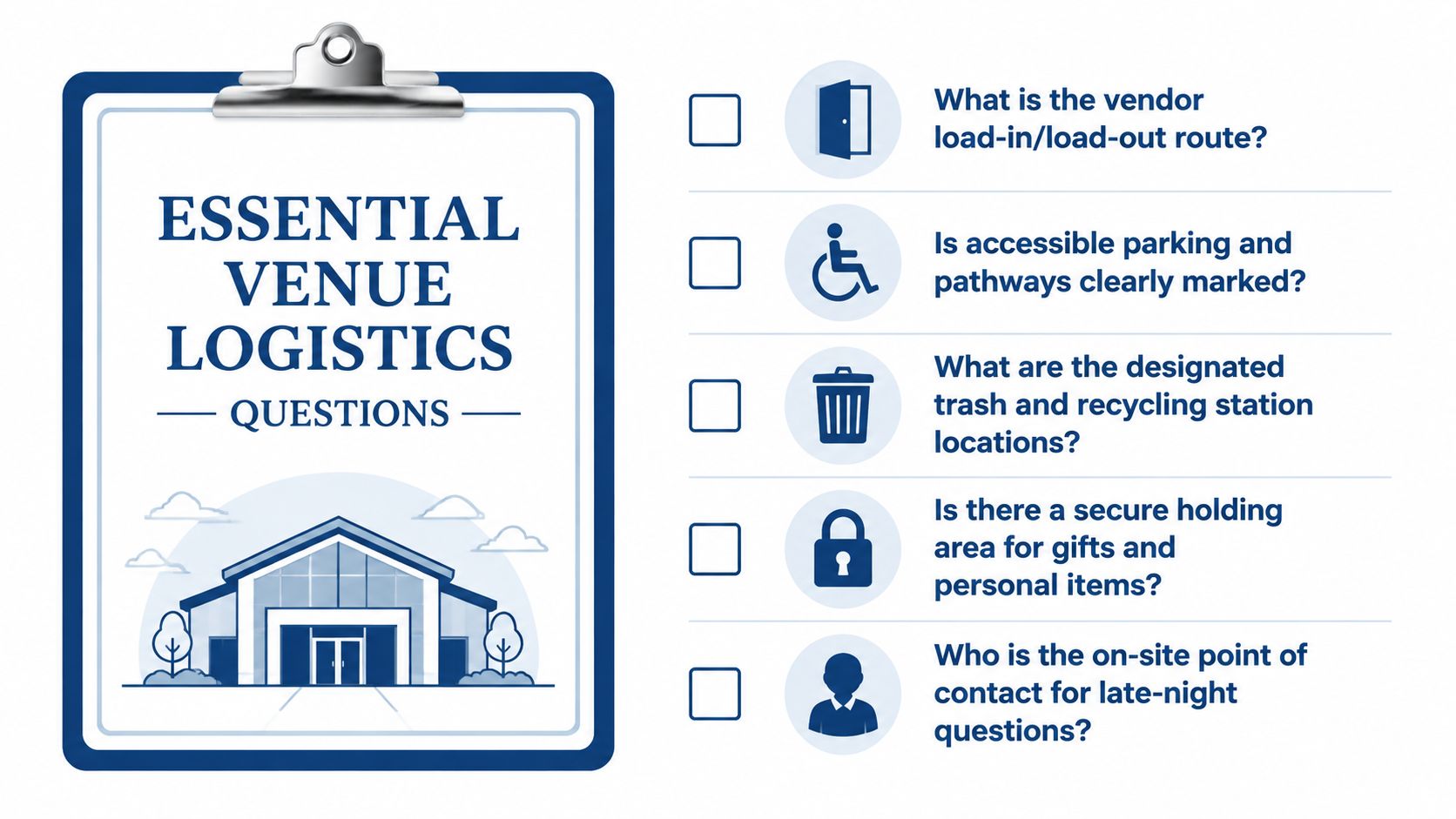
- Who manages vendor load-in and load-out? Ask for the route, access times, vehicle restrictions, and staging location.
- What does furniture breakdown include? Confirm whether staff disassemble, stack, stage, and inventory tables and chairs.
- Where do personal items go? Establish a secure holding area and identify who collects décor, gifts, signage, and leftover supplies.
- Which cleanup tasks are excluded? Ask specifically about spills, catering equipment, rental returns, trash, recycling, and décor removal.
- Who handles late-night decisions? Get the on-site manager's role and the escalation process in the contract or event plan.
Budget transparency belongs in the same conversation. Ask whether the quoted price includes sales tax and gratuity, which services are bundled, and which vendors you'll contract separately. A venue quote is useful only when you can compare the complete operating cost and the labor required after guests leave.
For a wedding venue near Austin, TX, logistics reveal the venue's maturity. The right choice gives you a clear access window, named responsibilities, safe routes, coordinated vendors, and a written breakdown scope.
Texas Old Town offers four private halls, indoor and outdoor ceremony settings, an 8:00 a.m. to midnight exclusive rental window, on-site management, clean-up, and furniture breakdown in Kyle, Texas. Visit Texas Old Town to tour the property and ask exactly how your furniture plan, vendor load-out, and post-event reset would work for your celebration.