A food truck arrives at a wedding as a complete commercial kitchen on wheels: generator, refrigeration, propane, hand sink, fryer, and a serving window that has to face your guests. That changes the planning. A caterer's kitchen is standing long before you book it. A truck's kitchen has to be positioned, powered, fueled and temperature-checked on the morning of the wedding, against a ceremony timeline that won't wait.
The failures are rarely about the food. They're about a generator that trips at 7:10 p.m., a cold line that drifts out of the safe zone while the queue backs up in the sun, or a truck that turns out to produce fewer plates per hour than the schedule assumed. All three are checkable before you sign anything.
Table of Contents
- Food Truck Weddings at a Glance
- Power Loads a Food Truck Needs on Wedding Day
- Food Safety Temperatures for Truck-Served Food
- Guest Flow and Line Planning for Truck Service
- Parking, Ground and Permit Checks Before Setup
- Vendor Coordination and Weather Backup Plans
- Confirm Your Food Truck Plan Before You Book
Food Truck Weddings at a Glance
The Knot's 2023 Real Weddings Study, which surveyed nearly 10,000 newlyweds, found that 4% had a food truck at their celebration, according to The Knot's wedding food truck findings. Read that as scale rather than hype. In 1,000 comparable U.S. weddings, roughly 40 would include a truck. Food trucks have left the street fair and settled into private celebrations, but they haven't displaced the caterer.
That number measures presence at the event, not replacement of conventional catering. A truck might carry the whole dinner, a cocktail-hour course, dessert, or a late-night snack. The study draws on a U.S. newlywed sample, so it describes a national pattern, not a promise about your venue or your date.
What That Share Does Not Tell You
For an outdoor, rustic or flexible-format venue, the figure matters because a truck fits the setting without asking the site to build a kitchen. It also tells you the demand is established, so vendors exist to call. What the percentage can't tell you is whether a given truck can hold temperature, carry its own power and clear a queue on your timeline.
Fuel sits behind all of it. A truck running a flat top and a fryer through a three-hour service burns propane far faster than it does on a weekday lunch shift, so operators who work private events keep spare cylinders on the property rather than hunting for a refill mid-reception. Venues that host trucks regularly work with suppliers for cylinder exchange for event venues so a swap takes minutes instead of a supply run.
The one test that frames everything below: can this truck keep serving the contracted guest count, outdoors, on the planned timeline, with no gap in power, temperature or queue? Every check in this guide measures a vendor against that sentence.
Power Loads a Food Truck Needs on Wedding Day
Electrical capacity is the constraint couples discover last. Published mobile vending power load guidance puts the demand in bands, and the band your truck sits in decides whether a venue circuit works or a generator gets rented, per mobile vending power load guidance.
| Truck setup | Estimated running watts | Main load drivers |
|---|---|---|
| Propane cooking with refrigeration, lights, water and POS | 3,500–5,000 W | Refrigeration, lighting, water pump, point-of-sale equipment |
| Propane cooking plus electric griddle or fryer | 7,500–9,500 W | Electric griddle or fryer added to the base load |
A propane-cooking truck that draws electricity mainly for refrigeration, lighting, water and point-of-sale gear may need roughly 3,500–5,000 running watts. Add an electric griddle or fryer and the requirement climbs to about 7,500–9,500 watts. That jump matters because the electric cooking equipment sits on top of the base load, not in place of it.
Running watts are only half the arithmetic. Compressors and motors pull a startup surge several times their running load, and the sizing has to include it. A generator matched to the running total but not the surge will hold through prep and fail when the refrigerator kicks on mid-service.
The Failure Chain to Design Against
An undersized generator or an unsuitable venue circuit trips at peak dinner service. Refrigeration stops, cooking stops, and a queue forms at the exact moment every guest decides to eat. Recovery takes time you don't have, because compressors need to cycle and hot holding has to be re-established before anything else leaves the window.
A generator that passes at idle tells you nothing. The only meaningful test runs every burner, compressor, fan and light at once.
Five Checks Before You Sign
- Request a nameplate load schedule. It should list refrigeration, fryers, griddles, exhaust fans, hot boxes, water heaters, lighting, POS systems and air conditioning, each with its running and startup figure.
- Confirm self-powered or shore power. Then identify exactly where the connection happens and who supplies the cord.
- Route cables off pedestrian paths. On an outdoor site, cable runs belong behind tables or under matting, never across the walk from ceremony to reception. The outdoor wedding setup shows how ceremony, reception and service areas sit relative to each other.
- Test at full simultaneous load. Not at idle, and not with half the equipment warming up.
- Agree a backup for refrigeration and hot holding. Coolers with ice and insulated hot boxes are cheap insurance against a tripped breaker.
Fuel and power decisions belong together when the truck cooks on gas. Operators who run high-volume equipment on site usually line up propane for restaurants and outdoor venues before the event rather than on the day, because a cylinder that runs dry stops service as completely as a tripped breaker.
A passing test looks like a full service block with everything running together, no trip, no dimming, and generator headroom left in reserve. Anything less is a rehearsal for a failure.
Food Safety Temperatures for Truck-Served Food
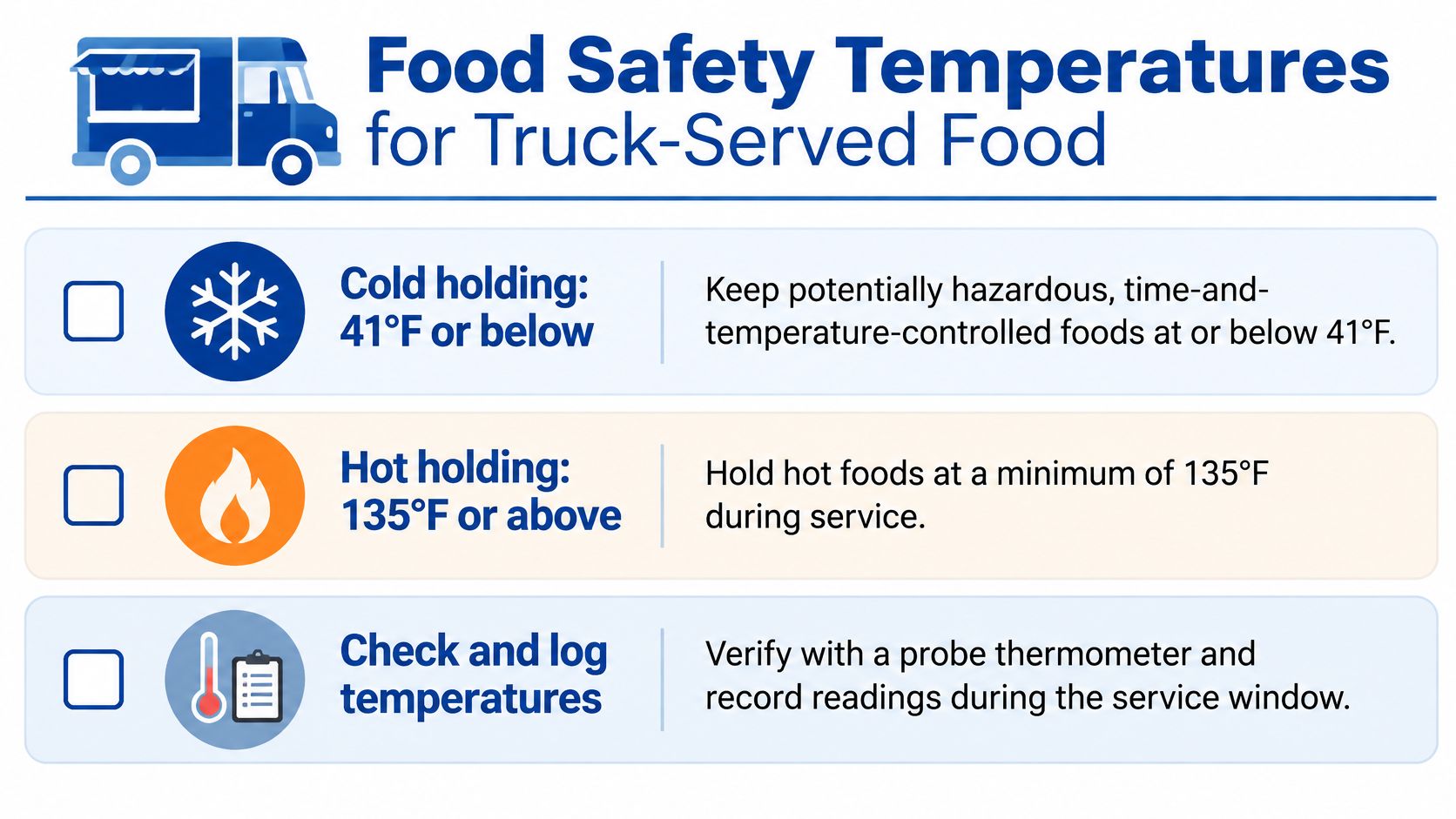
Temperature control is a service specification, not a catering detail. Mobile-food-unit guidance requires potentially hazardous, time and temperature controlled foods to hold at two thresholds, monitored with a working thermometer, per the Virginia Department of Health mobile food unit guide.
| Holding type | Required temperature |
|---|---|
| Cold holding | 41°F or below |
| Hot holding | 135°F or above |
Outdoor ceremonies and receptions stretch the time food spends outside controlled conditions. Travel distance, ambient heat and a long queue all push in the same direction, and a truck that holds temperature perfectly at 5 p.m. can be fighting a losing battle by 7.
What the Caterer Should Hand You in Writing
Ask for four things and read them before the tasting, not after the deposit.
- Holding-unit capacity: how much cold and hot food the truck can hold at once, in pans, not in promises.
- Temperature-check intervals: how often someone probes and who signs the log.
- Corrective actions: what happens when a reading drifts, including which items get discarded rather than rushed.
- Maximum service time: the longest a dish can legally and safely stay in the window.
Menu design affects both risk and throughput. Braised meats, rice and roasted vegetables batch-hold well and reduce last-minute cooking. Made-to-order assembly and tightly controlled items need smaller replenishment batches and closer monitoring.
Stage the Handoff, Not Just the Truck
Our prep kitchen with its separate service entry gives a truck a staging point away from guest traffic, and couples can bring the caterer they want. None of that removes the need for a written handoff plan. Write down truck arrival time, food transfer, buffet replenishment and post-service disposal, and name the person responsible for each.
Before booking, request the vendor's health-permit status, food-safety plan, calibrated thermometer procedure, backup refrigeration or hot-holding capacity, and contingency for equipment failure.
The benchmark isn't whether the truck can prepare your menu. It's whether it can hold compliant temperatures continuously while serving the guest count on your contract.
Guest Flow and Line Planning for Truck Service
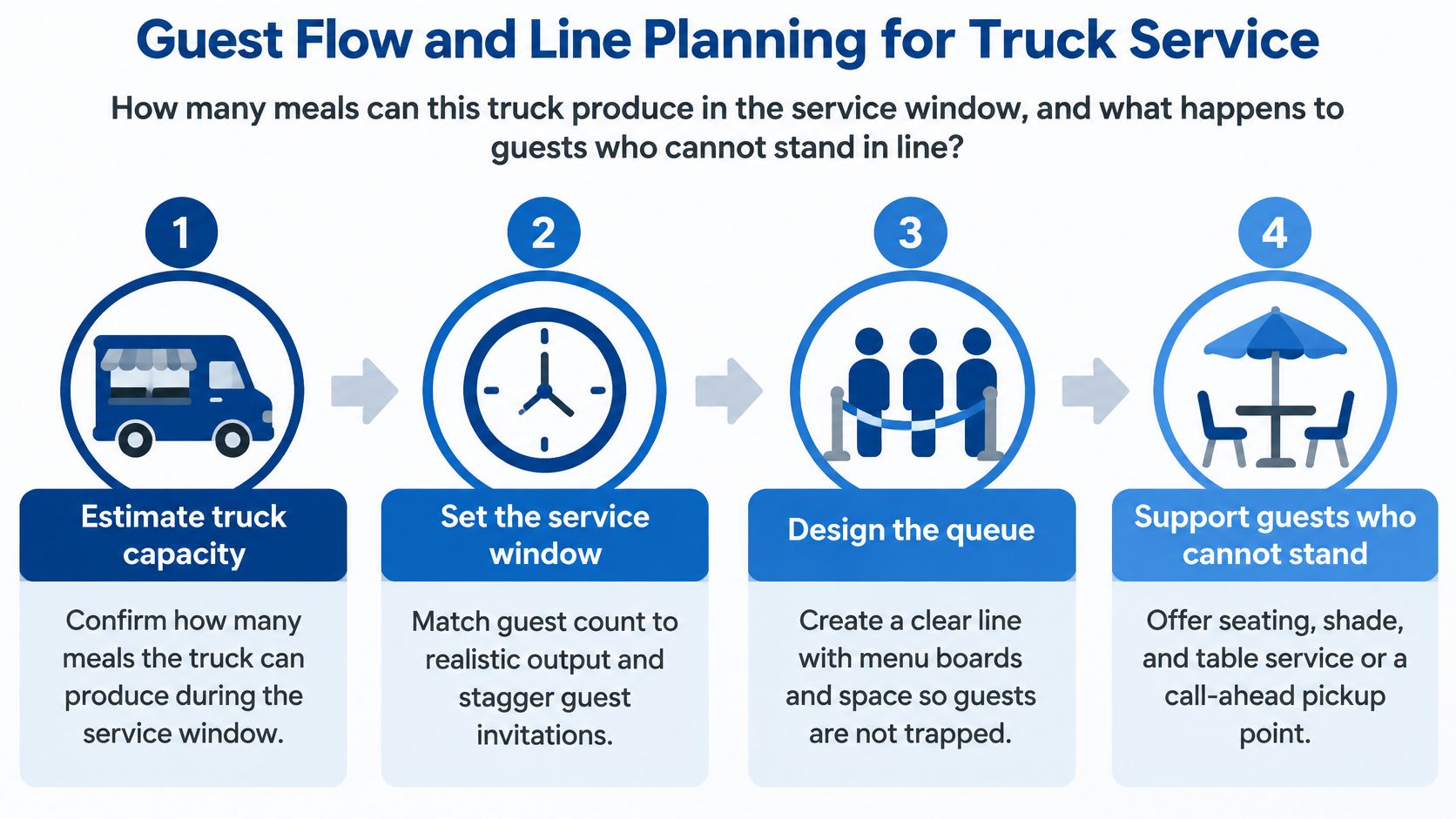
A food truck can serve a wedding well, but only when the line fits the reception timeline. Start with output, guest movement and the guests who cannot queue. Wedding coverage identifies wait times as a core disadvantage of truck catering and recommends additional trucks, limited menus, staggered service or pre-ordering, while a separate planning guide suggests two trucks can improve flow for a 150-person event, per wedding food truck catering guidance.
Capacity is simple arithmetic. Use this formula: guest count ÷ (meals per hour per truck × hours in the service window) = trucks needed. A 150-guest wedding with two hours of service and a 40-meal-per-hour truck needs 150 ÷ (40 × 2), or 2 trucks. That calculation sets the baseline. It does not absorb late arrivals, second helpings, slow payment, or a rush immediately after the ceremony.
Build the Flow Plan in Five Moves
- Get the output numbers. Estimated meals per hour, maximum simultaneous orders, staffing level and menu complexity, all in writing.
- Shrink the menu. A tight menu or pre-selected guest choices moves faster than a board with eight options.
- Release tables one at a time. Ten tables dismissed at once creates a crowd; a rolling release creates a line that moves.
- Set a priority ordering point. Elderly guests, wheelchair users, children and guests with medical limits shouldn't queue for a plate.
- Add a stationary station for the peak. A salad, sides or dessert table beside the truck takes pressure off the window without hiring another vehicle.
| Guests | Meals to serve | Service window | Meals per hour per truck | Trucks needed |
|---|---|---|---|---|
| 150 guests | 150 meals | 2 hours | 40 | 2 trucks |
| 250 guests | 250 meals | 2 hours | 40 | 4 trucks |
| 320 guests | 320 meals | 2 hours | 40 | 4 trucks before peak buffer, 5 with buffer |
The rate of 40 meals per hour per truck is illustrative, so it does real work as a template. Replace it with your vendor's stated figure and the table becomes a decision tool instead of a wish. Build in a buffer when the menu is made to order, when payments are slow, or when the reception schedule compresses arrivals.
Line placement matters as much as truck count. A queue that cuts across the dance floor, bar, photo area or ceremony exit will stall the room even when the truck is keeping pace. Give the truck a clear order side and pickup side. Keep condiments, napkins and utensils away from the service window so guests do not stop in the flow lane. If the venue has covered patios and gardens, place overflow seating where guests can wait without blocking the truck's work zone.
Write the Guarantee Into the Contract
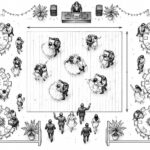
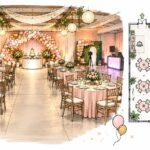
A service-time guarantee turns a friendly conversation into an obligation. Specify the window food is available, the maximum acceptable wait, and what happens if the truck falls behind. Then share your room layout with the truck so the queue doesn't form across a dance floor or block a bar. Our wedding venue floor plans give you the dimensions to plan that line before the day.
Food trucks feel more experiential than a buffet and are less operationally predictable. The flow plan is what decides which of those two facts your guests remember.
Parking, Ground and Permit Checks Before Setup
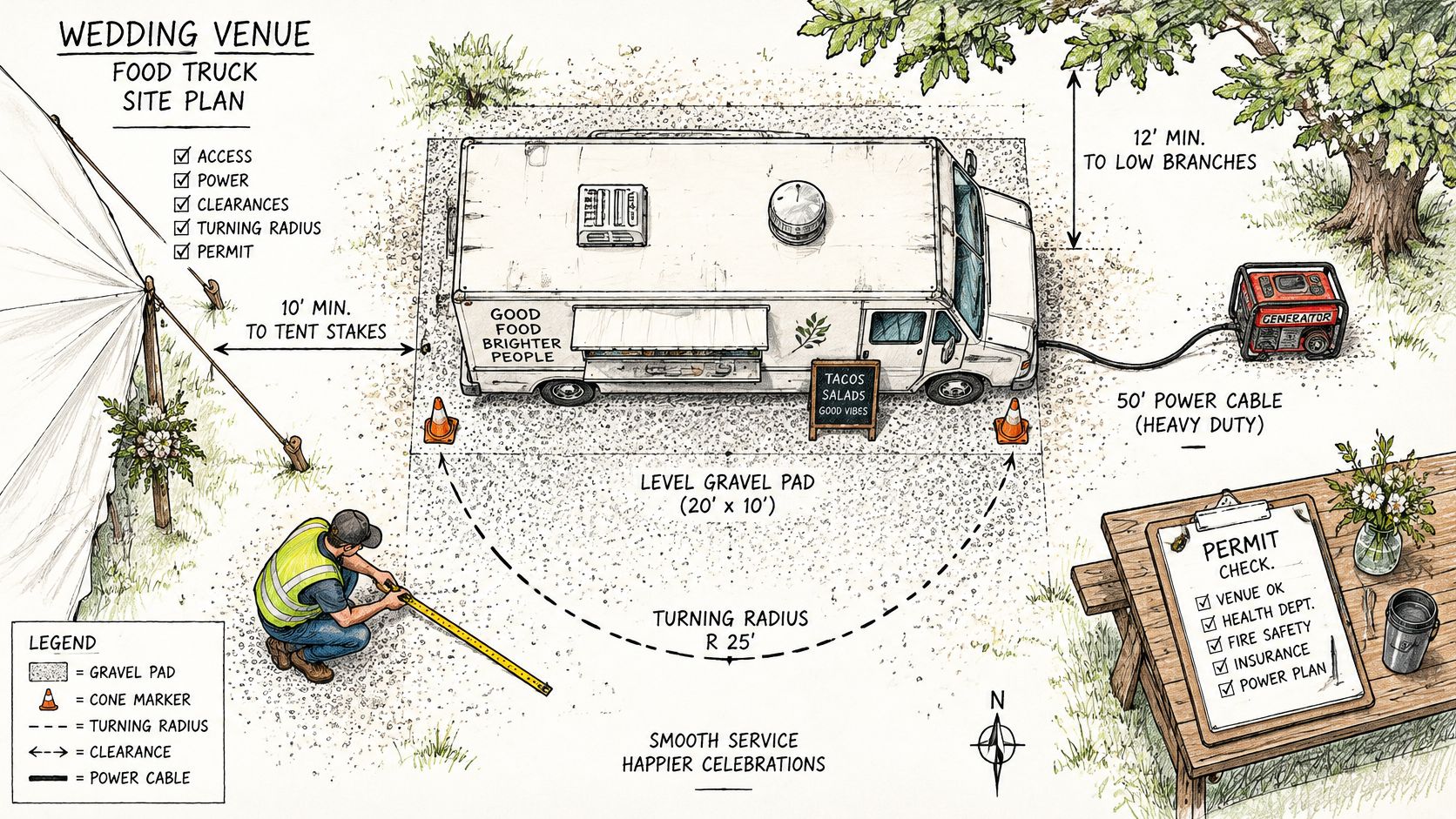
Food truck placement is site engineering. Level ground, turning radius, overhead clearance, power, water, waste, fire access and guest routes all affect one another. Move the truck a few feet for a better photo, and the cable run, queue and service window can all change. That is why a food truck plan belongs in the reception timeline, not just the parking notes.
The Interactions Nobody Assigns
A generator can intrude on ceremony audio, neighboring guests and evening quiet hours. Cables create trip hazards. A truck parked for a good photograph can end up far from the tables, creating a longer walk for every guest, including guests with mobility limitations. Weather, noise, soft ground and a blocked access route can each invalidate the original setup.
Permit details depend on the local authority having jurisdiction over the venue address. Generator permitting and site-map requirements should come from that office, along with the required locations for food service, waste, equipment and any other items the local rules specify. A generic “check permits” note is too vague to build a setup around.
The Site-Walk Checklist
Walk the property with the truck operator and the venue manager, and take these twelve items in order.
- Dimensions and turning radius: overall length, height and the swing needed to reverse out.
- Surface loadability: pavement or hard-packed material, with a plan for soft ground after rain.
- Fire-lane access: the route stays clear for emergency vehicles at all times.
- Generator decibels and hours: measured at the ceremony site, not at the truck.
- Weather cover: a canopy at the serving window so guests and crew stay dry.
- Accessible queue and pickup: level path, no gravel, no step.
- Water and wastewater: supply point and disposal plan.
- Sanitation: hand-wash station, gloves, refuse stations sized for the guest count.
- Insurance certificates: current, with the venue named as additional insured.
- Fire compliance: propane spacing and extinguisher placement signed off.
- Indoor fallback: the alternate station if the truck can't operate where planned.
- Parking separation: each reception hall at Texas Old Town has its own lot. All vehicles except the couple's and those of guests with disabilities park in the designated lot, so the truck route must keep clear of them.
The practical test is simple: the truck can arrive, level, connect, serve and leave without forcing guests or staff to solve a problem in real time. A venue's food-truck value depends less on menu novelty than on whether mobile catering can operate as reliably and accessibly as conventional catering.
Vendor Coordination and Weather Backup Plans
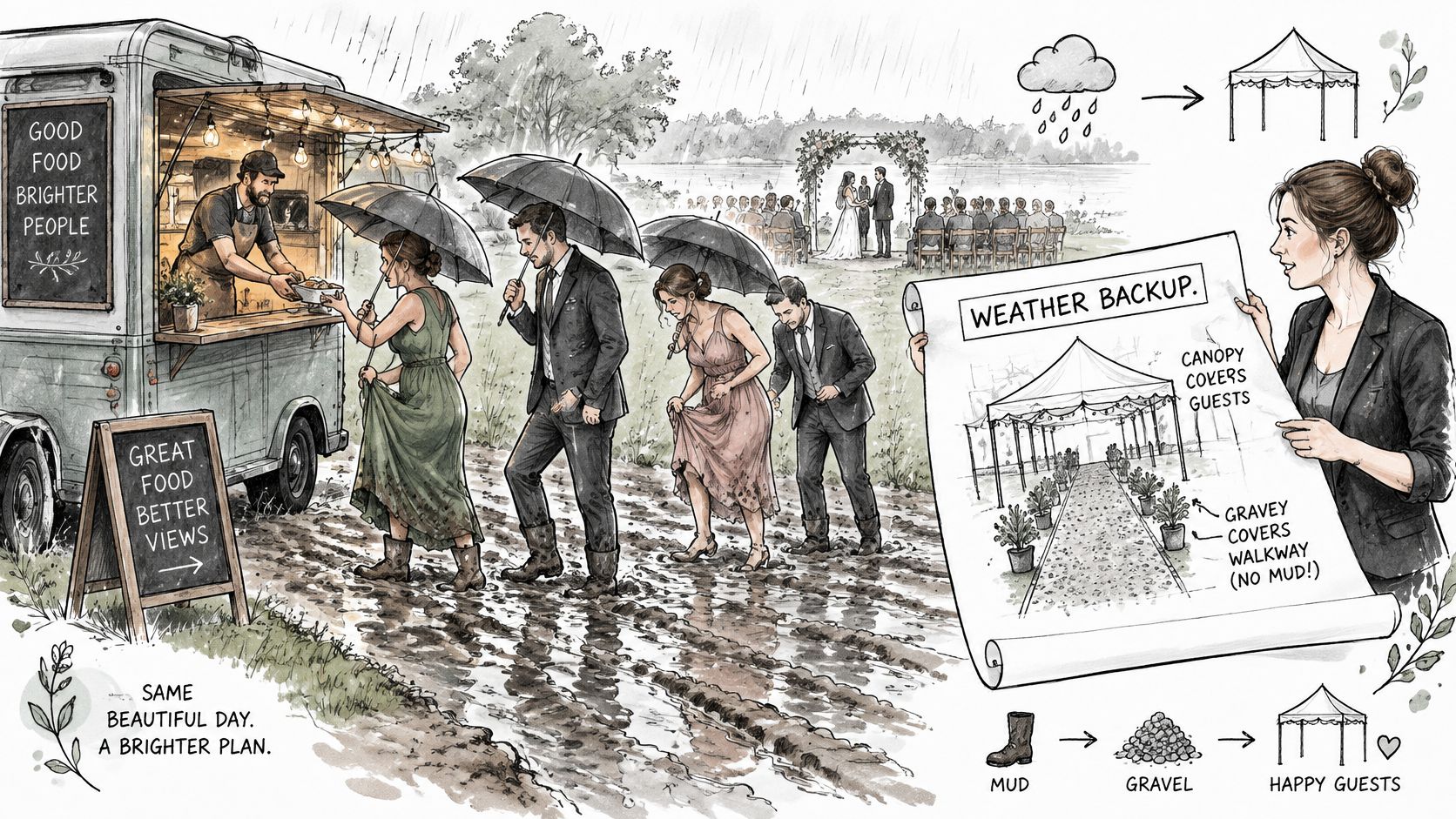
Say the truck is parked for the best view of the ceremony, facing the arch. Then rain softens the ground, guests cut across the lawn and sink to their ankles, and the serving window is suddenly on the wrong side of a mud pit. Nobody owns the problem because nobody was assigned the problem.
Every task needs one accountable name, written into the vendor contract: truck arrival, the power check, queue marshalling, temperature logs and breakdown. Ambiguity between a venue manager, a planner and a truck owner is where timelines fail.
Set the Arrival Clock First
Couples here choose their own vendors, and the truck contract should match our prep kitchen's service entry and access window. Redbud Hall clients have had venue access from 8 a.m. until midnight, which leaves room to position a truck early and test power before a single guest arrives. A truck that arrives 90 minutes before service is on time. A truck that arrives 90 minutes before service with a generator problem is late.
Five Steps to a Weather Plan That Runs
- Name the owner. One person can call the weather decision, and everyone has that person's number.
- Fix arrival and test times. Power test complete before the first vendor load-in ends.
- Agree the trigger and who calls it. Rain intensity, wind speed or ground condition, decided in advance.
- Define the alternate station. Indoor or climate-controlled space, with a buffet-style setup mapped out.
- Reissue the timeline. Every vendor gets the revised schedule the moment the call is made.
Heat belongs in the same plan. Shade at the queue, water within reach and a truck interior that isn't in direct sun all keep service moving; an overheating truck slows down before it fails. Any tent gets a wind rule the operator and the venue both accept.
If no fallback exists, reconsider the truck. A backup plan that lives only in someone's head is not a plan, it's a hope with a timeline attached.
Confirm Your Food Truck Plan Before You Book
Four checks decide this, and they all happen before money moves.
- Power: a written load schedule, a full-load test and confirmed headroom.
- Temperature: documented holding capacity, check intervals, corrective actions and maximum service time.
- Flow: a meals-per-hour figure, a stated service window and a signed service-time guarantee.
- Site access: a completed site-walk checklist covering ground, route, power point, queue and fallback.
Get all four in writing from every truck you shortlist. Compare the documents, not the menus. A vendor who hesitates on a load schedule or a meals-per-hour rate is telling you something useful before you've paid a deposit.
The decision threshold is simple. If the truck can't pass a full-load test and can't give you a timed queue estimate you believe, choose a different format. Buffet service with a strong caterer beats a charming truck that stalls, and your guests will never know what you saved them from.
Our property suits this kind of planning: four private indoor and outdoor venues on 55 scenic acres in Kyle, Texas, with 8 a.m. to midnight access at Redbud Hall for setup, testing and breakdown, plus a prep kitchen with its own service entry. Couples here can bring the caterer or truck they want, which means the logistics are yours to run and ours to support. We publish the vendor policy in full on wedding venues that allow outside catering.
Start with one call. Bring your guest count, your preferred date and the name of the truck you're considering, and ask how the venue manager would schedule arrival, power testing and queue setup against your ceremony time. That conversation surfaces conflicts while they're still fixable.
Texas Old Town hosts weddings and private celebrations across four venues on 55 acres in Kyle, Texas, between Austin and San Antonio, with a prep kitchen and separate service entry built for outside caterers and food trucks. If you're weighing a truck for your reception, bring your date, guest count and vendor name to a tour and we'll walk the site with you, from the power point to the serving window. Visit Texas Old Town to check availability and see the grounds before you book.