Uncategorized

8 Small Intimate Wedding Ideas for the Hill Country

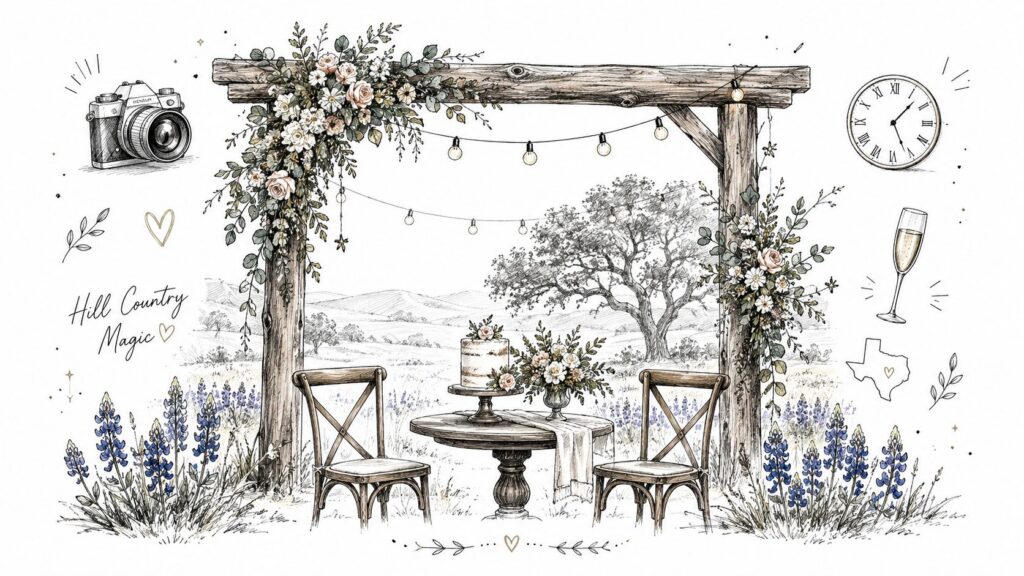
You're likely at the point where the guest list is getting smaller, the venue search is getting more specific, and the wedding finally feels like it can be personal instead of performative. That's the right moment to think beyond “small” as a headcount and start designing a celebration that feels intimate, especially if you want a Hill Country setting with room for real conversation, good food, and a timeline that doesn't feel rushed. The strongest small intimate wedding ideas do more than reduce scale. They use the smaller guest count to improve the experience, so every choice, from the room layout to the ceremony sequence, feels intentional. At a venue like Texas Old Town in Kyle, that usually means leaning into the property's 16-hour rental window, indoor and outdoor ceremony options, flexible vendor policy, and distinct spaces like Redbud Hall, which can support an event that feels relaxed without becoming casual in the wrong way. For many couples, the challenge isn't finding ideas. It's figuring out which format works for the people, weather, budget, and family dynamics involved. The ideas below are built for that reality, with practical ways to make a small wedding feel warm, organized, and memorable instead of stripped down. Table of Contents 1. Backyard-Style Elegance in a Historic Hill Country Setting Make the property feel like a family place, not a banquet hall 2. Rehearsal Dinner to Intimate Reception Sequence Use two gatherings for two different circles 3. Weekday Micro-Wedding With Premium Amenities Keep the timing guest-friendly and photography-friendly 4. Elopement Celebration With Family Dinner Keep the ceremony private, then widen the circle 5. Multi-Day Family Reunion Wedding Build a weekend that makes travel worth it Stagger the labor so nobody burns out 6. Intimate Renewal of Vows With Grandchildren Participation Let younger family members have real roles 7. Courthouse + Hill Country Celebration Lunch Give the celebration a different mood than the legal ceremony 8. Proposal Celebration or Engagement Party With Intimate Reception Use the party to test the feel of the venue 8 Intimate Wedding Ideas Compared Your Intimate Wedding, Perfectly Planned 1. Backyard-Style Elegance in a Historic Hill Country Setting A backyard-style wedding works when you want the comfort of a home celebration without managing one. At Texas Old Town, that feeling is easy to create in Redbud Hall or at the outdoor ceremony site, because the property gives you the relaxed visual language of a private gathering while keeping the infrastructure of a staffed venue underneath it. That combination matters more than couples expect. A true backyard wedding can be charming, but it also brings weather uncertainty, parking problems, bathroom logistics, and a lot of unseen labor for the host family. A venue-based version keeps the look soft and personal while letting the couple focus on the people in the room instead of the cleanup after they leave. Make the property feel like a family place, not a banquet hall The best execution uses the outdoor ceremony site for vows, then moves guests indoors for dinner. That shift keeps the event from feeling flat, and it lets the setting do more work without forcing everyone to sit in one space for hours. The 55-acre Hill Country property, with its water features, streams, and gardens, gives you enough visual variety to make the day feel lived-in rather than staged. Practical rule: Let the outdoor space handle the emotional moment, then let the hall handle the conversation and meal. For a multi-generational Texas family, that format feels especially natural. Picnic-style receptions, family-style dining, and a relaxed processional work well here because the event can stay warm without becoming informal in a way that loses structure. Ask the on-site manager which garden edge or water feature photographs best, then have your caterer stage dinner service through the prep kitchen so the transition feels smooth. A vendor who already understands the venue layout helps a lot. The flexible vendor policy means you can choose the right caterer, but a preferred vendor who knows the kitchen and service flow can save the day from unnecessary friction. 2. Rehearsal Dinner to Intimate Reception Sequence Some of the strongest small intimate wedding ideas start before the wedding day. A rehearsal dinner followed by a separate reception gives you two distinct moods, which helps when you want to honor the wedding party or extended family without making the main guest list feel crowded. Texas Old Town works well for this format, and the venue's own rehearsal dinner guidance is useful for couples who want to spread the celebration across more than one evening. The format also lowers pressure. The first night can focus on toasts, cultural traditions, and family connection. The second can stay centered on the marriage itself. Use two gatherings for two different circles A rehearsal dinner for immediate family and the wedding party gives a clear place for the people who helped carry the planning load. The reception the next day can stay smaller and more focused, which often makes the wedding feel calmer and more personal. That works well for destination guests too, because the out-of-town crowd gets a proper welcome before the main event. Keep the same caterer for both events if you can. That keeps the menu consistent and usually makes logistics easier, especially when the events happen a day or two apart. One evening can feel formal, while the next can allow more celebration, with dancing and speeches held for the reception instead of stretched across both nights. Split the emotional labor. Put the heartfelt speeches at rehearsal dinner, then let the wedding day breathe. If both events are booked at the same venue, ask the on-site manager how breakdown from the first event will line up with setup for the second. That detail matters more than many couples expect. It is the difference between a polished weekend and one where staff are constantly resetting the room in front of guests. For couples comparing spaces and logistics, small wedding venues with flexible
How to Plan Wedding Budget: A Practical Guide

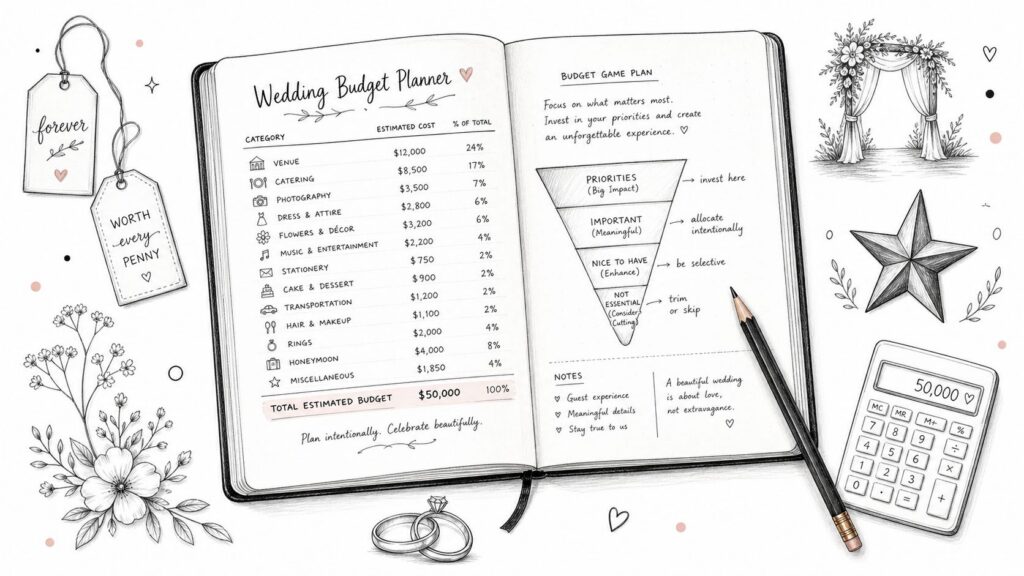
You're engaged, the venue tour is on the calendar, and the budget is still a moving target. That's the moment couples usually get into trouble. They start with a number that feels reasonable, then let guest count, upgrades, and contract fine print drag them into a wedding they didn't plan to buy. If you want a clean answer to how to plan wedding budget, stop treating the budget like a wish list. Build it from cash, not vibes, then let the venue and guest list tell you what kind of wedding you can afford. That's the only way to avoid falling in love with a date, a room, and a menu before you know what the math can support. How I Picked These Wedding Budget Strategies I've spent years watching couples build budgets around Hill Country venues, and the methods described here survived a simple filter. A budgeting approach earned a place here only if it passed three tests: it had to account for what the venue already includes, it had to scale cleanly when the guest count changed, and it had to respect a realistic payment timeline instead of assuming all the money shows up at once. What disqualified a method was just as important. Flat-percentage formulas got cut when they ignored contingency reserves or assumed every venue costs the same to outfit. Any advice that told couples to "set a number" without auditing the venue quote first got cut too, because that's exactly how couples end up short on service charges they never saw coming. The guidance below has been refined through repeated booking seasons, and I've adjusted it after watching the same overruns happen in the same categories, florals and staffing most often. If a rule didn't hold up when real contracts and real deposits were on the table, it didn't make this article. Setting a Realistic Total Before You Book Anything The first mistake couples make is calling a number a budget when it's really just a hope. You don't need a prettier guess. You need a hard ceiling built from what's available, then a working budget underneath it. Start with three buckets. Add up liquid savings, confirmed family contributions, and the monthly amount you can set aside before the wedding date. That total is your ceiling, not your spending target. Keep a separate working budget below it, because you should reserve contingency money before you assign a dollar to flowers, linens, or signature drinks. Practical rule: Don't touch a vendor spreadsheet until you've carved out your cushion. If you spend the contingency on upgrades, you're not "staying flexible," you're just removing the only protection you have. Couples usually need a reality check from someone who sees contracts all day. Budget planning guides from EasyRegistry's budget wedding advice make the same basic point, keep the total honest and cut waste early. That's right, but it's still too vague on its own. The better move is to decide, in writing, what the wedding can cost before you tour a venue with gorgeous landscaping and a seductive cocktail hour. One tool that has helped couples in my experience is putting the three-bucket math into a dedicated system rather than a notes app. Superchat's guide to AI personal finance assistants walks through how these tools can track savings progress and flag spending drift, which is useful when your wedding savings window is only 10 or 12 months long. Use the venue hunt as a filter, not a fantasy builder. If you're still narrowing where to marry, this wedding venue selection guide helps you compare spaces without pretending every site costs the same. Book nothing until your ceiling, cushion, and first-priority categories are set. What a Wedding Budget Actually Looks Like in Central Texas National headlines are only useful if you know how to read them. The Knot's Real Weddings data reported an average U.S. wedding cost of about $34,000 in 2025 (The Knot). Guest count moves the total fast, too: weddings with 50–75 guests average around $21,500, while 150–200 guests average $45,000 (Zola). Is $10,000 or $30,000 realistic in Texas? In my general observation of Hill Country weddings, $10,000 can absolutely work in Central Texas if the guest list stays under about 60 people and the venue absorbs rentals and logistics. Tables, chairs, cleanup, and on-site management included in one package change that math more than any other single decision. At 150 guests, $10,000 stops being workable because food and service alone become the dominant expense at seated-meal prices. A larger budget, meanwhile, performs more comfortably for a mid-size Central Texas wedding at a full-service venue. Historical data reminds us that even modest shifts in the national average can move your personal line items through inflation, overtime, delivery charges, and staffing (The Knot). The 50/20/30 split is a draft heuristic I use as a starting frame for couples who begin with a hard ceiling: roughly 50% of the budget to the venue-and-catering core, 20% to photography and attire priorities, and 30% spread across everything else. In my general observation, it works well for couples who set a ceiling first, though many still underestimate site fees and service charges, so treat the split as a draft, not a contract. Where the money goes first The smartest budget planners don't start with decor. They start with the categories that swallow the biggest share. The Knot's 2026 Real Weddings Study found venue and rentals at 29%, catering, cake, and drinks at 24%, and photographer and videographer at 10% (The Knot). Those are the lines that set the tone, eat the fastest, and punish underestimates. Now add a Hill Country venue into the equation. A property with tables, chairs, cleanup, on-site management, and a long rental window absorbs expenses many generic budget guides assume you'll pay separately. That doesn't make the venue cheap. It makes the math more honest. You're not just buying a room, you're removing several outside rentals and a chunk of day-of coordination from your budget. Category Share of

Event Manager Responsibilities: A Complete Guide for 2026

You're not just trying to “have an event.” You're trying to keep a room full of moving parts from colliding. The florist wants access before the band arrives, the caterer needs a clear path to the prep kitchen, the family wants a calm timeline, and someone still has to answer the question nobody asked early enough, who's in charge when the schedule slips? That's where event manager responsibilities stop being a vague job title and start looking like operations. A strong event manager keeps the budget, vendors, timeline, guest flow, and contingency plans moving together, which is why the U.S. Bureau of Labor Statistics treats the field as a real profession with a 2023 median annual wage of $56,920 and 8% projected employment growth from 2023 to 2033 for meeting, convention, and event planners (BLS occupational outlook). In a venue like Texas Old Town, where one property can host weddings, quinceañeras, and corporate functions across multiple halls, the role becomes even more visible because every decision has to fit a live building, a fixed access window, and real people on the ground. For a first-time client, that can feel abstract until the day starts. For a junior planner, it can feel like the job changes every hour. The simplest way to understand it is to see who owns what before, during, and after the event, because that's where accountability lives. Table of Contents What an Event Manager Actually Owns on Event Day Who owns the decisions The real job on the floor The Three Lifecycle Phases of Event Manager Responsibilities Pre-event creates the operating rules Day-of turns planning into movement Post-event closes the loop Pre-Event Responsibilities and a Realistic Planning Timeline A workable countdown What should be in the planner's hands How Day-Of Responsibilities Shift by Event Type Weddings need ceremony choreography Quinceañeras need multi-generational coordination Corporate events need structure and timing Post-Event Responsibilities Most Planners Underestimate What still needs to happen after guests leave The deliverables that should exist every time Skills, Staffing, and the On-Site Manager as Force Multiplier What the manager must be able to do When to add more support Questions to Ask Your Venue's On-Site Manager The questions that reveal real scope What good answers sound like Common Questions About Event Manager Responsibilities What an Event Manager Actually Owns on Event Day A planner can arrive before sunrise and still feel behind. One vendor is at the gate, the couple has a question about seating, the caterer wants to know when the hall is clear, and the AV team needs to test sound before guests see the room. On event day, event manager responsibilities are less about “running the show” in a theatrical sense and more about making sure every handoff happens in the right order. Who owns the decisions The client-hired event manager usually owns the master timeline, vendor communication, issue escalation, and on-site sequencing. A venue's on-site manager owns the property-side pieces, access rules, facility coordination, and the in-house handoff points that keep the building operating safely and on schedule. Those two roles overlap, but they are not the same job, and that difference matters when something changes at the last minute. At a venue with included on-site management, like Texas Old Town, the venue layer already exists inside the operation. That means the planner isn't trying to locate a property contact in the middle of setup, they're working with a built-in operational partner who can help keep movement, access, and breakdown aligned with the venue's own rules. Practical rule: If the issue is about the event's design, guest experience, or vendor sequence, the event manager leads. If the issue is about property access, venue systems, or cleanup handoff, the on-site manager should be part of the decision fast. The real job on the floor The best event managers think in sequences. They confirm load-in order, make sure the room can shift from setup to ceremony to reception without conflict, and stay ahead of the kind of small delay that becomes a larger one five minutes later. That's why the role is tied to budgeting, scheduling, venue selection, vendor coordination, technical needs, and on-site execution in the BLS description, because all of those tasks connect in practice (BLS occupational outlook). For a simple planning tool, many teams keep a written room-flow reference nearby. A practical example is the reception schedule template, which helps turn “we'll figure it out on the day” into a sequence with actual timing. The Three Lifecycle Phases of Event Manager Responsibilities The easiest mistake is to think event management starts when guests arrive. It doesn't. A late vendor check-in or an unclear contract term in the planning stage shows up later as a rushed setup, a stressed client, or a room that never fully settles into the right flow. Pre-event creates the operating rules Modern event manager responsibilities now cover planning, budgeting, vendor negotiation, marketing, staffing, logistics, and post-event analysis, not just day-of coordination (Instawork event manager job description). That broader scope matters because the pre-event phase defines the room's operating rules, from vendor arrival order to bar service requirements and setup timing. If the planner doesn't lock those choices early, the event day inherits uncertainty. That's why a structured venue schedule, such as the one used in a Texas Old Town event planning timeline, is more than paperwork. It becomes the working map for everyone who needs access, space, and timing. Day-of turns planning into movement On event day, the work becomes coordination under pressure. The event manager confirms the schedule, responds to changes, and keeps vendors from overlapping in ways that block the room or slow service. In a venue with a 16-hour rental window, there's more breathing room for setup, live execution, and breakdown than in a compressed rental model, which reduces the chance that one late arrival distorts the rest of the timeline. That extra room still doesn't remove the need for discipline. It just makes good sequencing more realistic. Post-event closes the loop

Venue Near San Antonio: A Complete Hill Country Guide

You're probably juggling three things at once right now. A parent wants a beautiful setting, your budget wants discipline, and the guest list keeps pulling you toward either a downtown hotel or something farther out in the Hill Country. That's exactly where a venue near San Antonio earns a serious look, especially if you need room for a real event, not just a photo backdrop. San Antonio isn't a tiny venue market. The city has 458 hotels and more than 48,000 guest rooms, and the Henry B. Gonzalez Convention Center brings over 1.3 million square feet of event space into the market, which is why planners here are often choosing in a crowded, high-capacity corridor rather than a niche destination (Cvent venue market data). In that kind of environment, the smartest venues don't just look pretty. They solve logistics, protect your timeline, and make the day feel calm. Table of Contents Why Choose a Venue Near San Antonio Why the corridor matters The Four Halls and What Each One Handles Best Tejas, Sage, Stone, and Redbud How to think about outdoor pairings Included Services, Policies, and On-Site Logistics The day runs on built-in logistics Pricing Expectations and Booking Timeline for 2026 What competitive pricing looks like How to judge your own timeline A Sample Wedding Day Schedule Built Around the 16-Hour Window How Wild Onion Ranch Compares to Other Central Texas Venues Matching the Right Hall to Your Event Type My direct recommendations What to ask about on a tour Planning Questions Worth Asking Before You Book Why Choose a Venue Near San Antonio Most couples begin with a downtown San Antonio ballroom, then realize the day starts to feel like a hotel conference with flowers. Others look west at ranch venues and find the drive harder than they want for older relatives, vendors, and anyone hauling gear. The Hill Country corridor between Austin and San Antonio solves that problem better than the city core does, which is why it keeps earning real tours instead of casual clicks. Why the corridor matters San Antonio's venue market is crowded, but crowding does not make the search easier. PartySlate lists wedding venues near San Antonio, and that alone shows how much competition couples are sorting through before they ever see a floor plan (PartySlate venue results). In a market like that, a single-property campus stands out because you are comparing real guest flow, parking, rain backup, and rental rules instead of trying to decode hotel package language. Practical rule: If the venue cannot clearly explain guest flow, parking, rain backup, and rental hours, keep looking. That is the advantage of a four-hall campus near San Antonio. You get range built into one property, from smaller gatherings to bigger guest counts, without forcing every celebration into the same room shape or the same hotel setup. For couples who want a broader explanation of why Hill Country properties keep pulling attention away from the city, this wedding venue near San Antonio guide gives that context in plain English. The location also works because it respects the people who have to show up. Families coming from both sides of Central Texas, vendors unloading decor, and guests who need direct access all do better when the venue functions like a campus instead of a tight urban room. If you want to sort the layout from polished photos, a private wedding album for venues gives you a cleaner read on the space before you tour. The Four Halls and What Each One Handles Best One of the smartest things about a four-hall property is that you stop pretending every event belongs in the same room. Tejas, Sage, Stone, and Redbud each serve a different kind of host, and if you match the hall to the event properly, you avoid the common mistake of overbooking space just because it feels safer. The right hall is the one that gives your guests enough breathing room without making the event feel empty. Tejas, Sage, Stone, and Redbud Tejas is the obvious pick when the guest list is large and the tone leans Texas-forward. It's the hall I'd point to first for a 320-guest country dance hall wedding, because that kind of celebration needs confident circulation, a strong dance floor, and space that doesn't collapse under the weight of dinner service and a full reception program. If you want the event to feel lively, not crowded, Tejas is the right starting point. For a closer look at that hall, see the venue's Tejas space page. Sage fits couples who want a large gathering without the look of a massive ballroom. It works well when you need ceremony-to-reception flow and want the room to feel tucked into the natural setting instead of flattened by it. I'd put Sage high on the list for events that need scale but still want some softness in the atmosphere. Stone is the hall for hosts who want the more polished side of the Hill Country without losing flexibility. It's a good fit for dinners, milestone celebrations, and corporate programs that need a room to feel professional during speeches and relaxed later in the night. Stone tends to make sense when the decor needs to look refined without becoming fussy. Redbud is the intimate choice, and that matters. For a 150-guest micro-wedding or a smaller family event, Redbud gives you the proportions you need instead of making you rent extra square footage you'll never use. It's also the hall I'd favor when the guest list is close-knit and the event needs to feel warm, not compressed. How to think about outdoor pairings Each hall gets stronger when the ceremony plan is aligned with it. An outdoor ceremony with a natural backdrop gives you a smooth transition into the indoor hall, while the indoor option keeps weather risk under control without changing the whole event style. That pairing is the advantage of a campus like this, not just the number of rooms. The point isn't to memorize

Payment Plans for Weddings: How to Budget and Pay Over Time

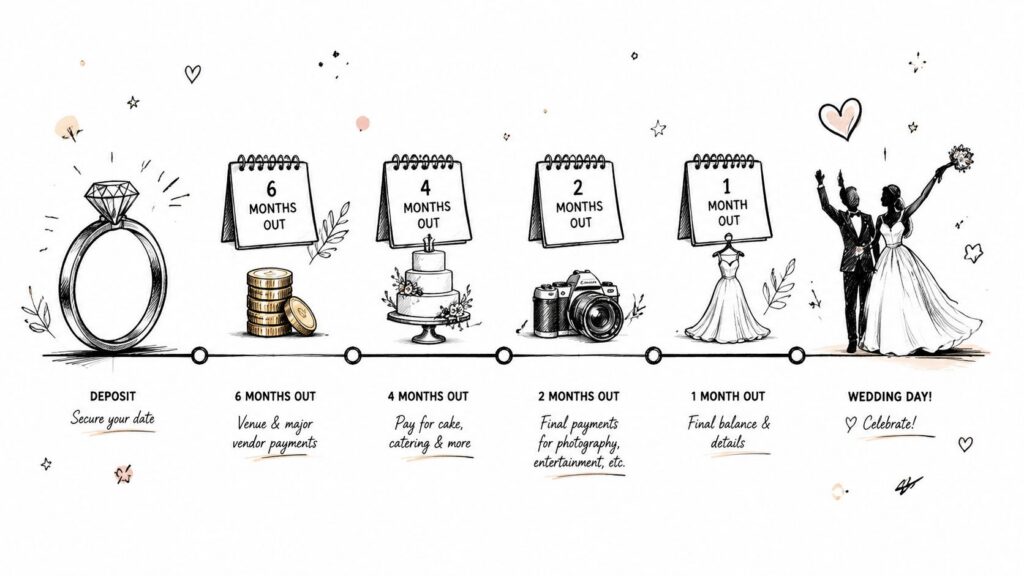
You can love the venue, the photographer, and the menu, then freeze the moment the contracts arrive. One payment is due now, another in a few months, and the dress shop wants its own schedule, while travel and guest counts are still moving around. That's where payment plans for weddings stop being a nice extra and start becoming a cash-flow tool you need to manage on purpose. The couples who handle this well don't just ask, “Do you offer installments?” They map every due date against what's in their savings account, then decide what can be paid now, what should wait, and what needs to be negotiated. That matters in a year where the average U.S. wedding cost is $36,000 and venue spending alone averages $8,573 (Zola's 2026 First Look Report). If you're trying to keep the wedding beautiful without creating a post-engagement debt hangover, the plan has to fit the calendar, not just the headline price. Couples also aren't looking for this by accident. Carats & Cake reported that 65.7% of couples were interested in flexible payment solutions and 78.8% expected to go over budget, which tells you exactly why this topic keeps coming up at venue tours and vendor calls (LendingTree's wedding debt survey summary). If you and your partner are trying to stay organized together, a simple tool that helps you track progress on shared goals can keep the wedding from taking over every money conversation. Table of Contents Why Wedding Payment Plans Matter More Than Ever The Three Main Types of Wedding Payment Plans Wedding Payment Plan Types Compared Building a Month-by-Month Wedding Payment Timeline Vendor Plans Versus Credit Cards Versus Saving Longer How Texas Old Town Structures Its Wedding Payment Plans Negotiation Tips and Budgeting Strategies for Any Venue Frequently Asked Questions About Wedding Payment Plans Why Wedding Payment Plans Matter More Than Ever A wedding budget can look fine on paper and still fall apart in practice. The trouble usually starts months before the final bill arrives, when the venue wants a deposit, the caterer wants a retainer, and the dress shop expects another payment before the bridal shower. Payment plans for weddings matter because they control timing, and timing is where couples get squeezed. That pressure gets worse when venue, catering, and bar services eat a large share of the budget, as shown in Zola's 2026 First Look Report. Installments help only if they match the rest of the wedding calendar. They spread the cost across the engagement instead of letting several big bills land in the same month. That matters because a low monthly payment can still collide with the florist, the photographer, and the final dress balance. If you do not map those dates first, the payment plan just hides the strain until it shows up again. Couples also make a bad habit of confusing a manageable installment with actual affordability. A smaller payment does not fix a budget that is already overloaded with venue fees, vendor retainers, attire, and travel. The better order is simple. Build the payment calendar first, then choose the vendors and financing that fit inside it. There is a reason this problem keeps coming up. LendingTree found that many engaged couples planned to take on debt for wedding expenses, often through credit cards, personal loans, or help from friends and family. That tells you how common wedding financing has become. It also shows why couples need a plan before the first deposit leaves the account. Practical rule: If a payment plan does not lower the risk of a mid-engagement cash crunch, it is not helping. It is just changing which bill hurts first. For Texas couples planning around a Hill Country venue or a regional guest list, the timing problem gets even tighter. Travel, attire, and vendor travel fees can stack on top of venue obligations, so the payment schedule has to cover the whole event, not just the reception space. Couples who want to track progress on shared goals should treat wedding payments the same way, as part of a bigger cash-flow plan that protects the rest of life, not a separate pile of bills. The Three Main Types of Wedding Payment Plans Wedding payment plans usually fall into three buckets, and you should know the difference before you sign anything. The first is the event-date anchored plan, where a deposit secures the date and the rest is tied to how close you are to the wedding. The second is a monthly amortization plan, which breaks the balance into equal monthly installments across the engagement. The third is a milestone-based plan, where payments land when specific planning steps are reached, like a tasting, final headcount, or design approval. The event-date anchored model is the one you'll see most often with venues. Industry templates for venues recommend a 30% deposit, a second payment at 90 days out, and final payment at 14 days out (VenueBill). A more advanced venue structure uses three to four installments with a first retainer of 25% to 50%, a mid-project payment of 25% to 30%, and the remainder before the wedding (HBMS). Venues like this because they're protecting a date that they can't sell twice. The monthly model works differently. It smooths out the pain if your engagement is long enough and your income is predictable. The downside is that it can make people feel more comfortable than they should, because the payment is small enough to ignore while other vendors build up. Milestone plans are useful when the vendor's workload really does move in stages, but they're less useful for couples who need a stable calendar more than a project rhythm. Wedding Payment Plan Types Compared Plan Type Typical Structure Payment Timing Best For Event-date anchored Deposit, mid-interval payment, final balance Tied to the wedding date Venues and couples who need clear deadlines Monthly amortization Equal monthly payments Spread across the engagement Longer engagements with steady savings Milestone-based Payments tied to planning checkpoints Tied to deliverables or approvals Vendors

10 Milestone Birthday Party Ideas for Every Age & Style

You've got the guest list started, the honoree's favorite cake flavor settled, and three different opinions on whether the party should feel elegant, casual, or somewhere in between. That's exactly where milestone birthdays get tricky. A 30th, 50th, quinceañera, retirement, or anniversary only works when the format matches the person and the people around them, not just the number on the invitation. At Texas Old Town in Kyle, the Hill Country setting, the four distinct halls, and the 16-hour rental window give you enough flexibility to build a celebration that feels personal without turning the day into a logistical marathon. Milestone birthdays usually land best when they mix social time, good food, and a memorable experience. That matches how people already celebrate, since many combine family time, meals, trips, or gatherings rather than relying on one big party model, according to a 2022 YouGov poll summarized by Stacker. The ideas below keep that reality in mind, then map each concept to a specific Texas Old Town venue so you can see what fits your guest count, style, and flow. Table of Contents 1. Elegant Decade Milestone 2. Quinceañera 3. Adventure and Experience-Based Milestone 4. Retirement Party with Legacy and Service Recognition 5. Milestone Vow Renewal and Marriage Anniversary 6. Milestone Birthday Charity Gala and Fundraiser 7. Milestone Family Reunion and Multi-Day Celebration 8. Milestone Destination Weekend with Local Experience Integration 9. Milestone Birthday with Surprise Party and Guest Coordination 10. Milestone Celebration with Technology Integration and Hybrid or Virtual Attendance Milestone Birthday Party Ideas, 10-Item Comparison Your Milestone Awaits at Texas Old Town 1. Elegant Decade Milestone A decade birthday deserves more than balloons and a folded cake table. For a 30th, 40th, or 50th, the strongest approach is a polished dinner with a few nostalgic details, not a room packed with gimmicks. A 50th at Texas Old Town's Sage venue can lean into a 1970s disco nod with a live band, while Stone works well for a formal reception that still feels warm and personal. The best version of this idea uses the venue's 16-hour access to remove pressure from setup. Start decorators early, then let florals, candles, photo displays, and place settings build gradually instead of rushing everything in before guests arrive. If you're using multiple courses, coordinate service timing with a caterer that knows how to pace speeches between plates. Practical rule: Keep the program short enough to preserve the dinner conversation. A milestone birthday should feel intentional, not like a conference agenda. For a rustic-elegant version, Tejas gives you the Texas character that pairs naturally with vintage-inspired décor, darker wood tones, and a more relaxed cocktail hour. Add a photo montage, a brief toast from one or two close friends, and a playlist that reflects the honoree's decade of birth. The result feels grown-up without becoming stiff. A useful local planning reference is Texas Old Town's own guide to birthday celebrations, which shows why the venue's layout and event structure work for milestone events in Central Texas, especially for birthday-party planning at the property. If you want a more style-specific starting point, milestone 40th birthday ideas can help you refine the tone before you book vendors. 2. Quinceañera A quinceañera needs enough room for ceremony, family time, photos, dinner, and a dance floor that can breathe. At Texas Old Town, pairing Stone or Sage for the formal portions with Tejas for the reception gives you that structure without forcing the entire celebration into one room. Separate spaces make it easier to honor tradition while keeping the evening organized. The 16-hour rental window matters because quinceañeras often need time for hair, makeup, family portraits, and the formal sequence before guests even sit down. Use the dressing suites for attendants, the outdoor areas for pre-reception photos, and the indoor hall for the main celebration. With enough time built in, the event feels composed instead of rushed. The cultural details also call for a vendor team that understands the tradition. Mariachi, a DJ, choreographed dances, and family participation all need clear timing, so a standard birthday-party setup usually falls short. A preferred vendor who has handled quinceañeras before can help you keep the honor moments in the right order and avoid awkward transitions. If you are comparing venue fit, Texas Old Town has a dedicated resource for families choosing a setting that matches the moment, Texas Old Town's quinceañera venues near Austin and San Antonio guide. That guide is useful when you are balancing religious, family, and social parts of the event at the same time. A well-planned quinceañera at this venue feels traditional without becoming rigid. The Hill Country setting gives the celebration room to feel special, while the hall choices let you shape the formality level around the family's priorities. For families who also need help styling related celebrations, Texas Old Town retirement party decoration ideas shows how the venue handles decor planning with the same practical focus. Some families want a quinceañera that includes a more active start before the reception. In that case, use the property for a walk, group photos, or a simple outdoor gathering first, then let the evening settle into dinner and dancing. Choose from the most popular outdoor recreation options to match the honoree's interests, then keep the rest of the schedule light enough for grandparents, younger cousins, and the dance court to stay engaged without feeling dragged from one part of the day to the next. 3. Adventure and Experience-Based Milestone Some honorees don't want a ballroom at all. They want motion, fresh air, and a celebration that feels active enough to match who they are now. For that kind of milestone birthday party idea, Redbud is the cleanest fit, especially if you want an intimate post-activity meal after a hike, group walk, yoga session, or lawn-game circuit. A good local example is a Hill Country birthday that starts with outdoor time across the property, then settles into BBQ and a relaxed gathering once everyone's ready to sit. Texas

Boho Wedding Venues: Top Picks for a Hill Country

You're trying to find a venue that already feels like the wedding in your head, not a blank ballroom you have to force into shape. In the Austin to San Antonio corridor, that usually means Hill Country views, natural textures, good sunset light, and a layout that won't collapse when weather or vendor timing gets messy. The strongest boho wedding venues do all of that without making you sacrifice comfort, flow, or guest experience. If you're also trying to keep the planning practical, it helps to match your ring to your daily life here: match your ring to your daily life. Table of Contents 1. Texas Old Town Why this venue works for boho styling What to style here and what to skip 2. Mae's Ridge How to make it feel boho, not corporate 3. Camino Real Ranch Why the scale matters Best ways to style Camino Real Ranch Boho Wedding Venues Comparison: Texas Old Town • Maes Ridge • Camino Real Ranch Bringing Your Central Texas Boho Vision to Life 1. Texas Old Town Texas Old Town is the kind of Hill Country property that makes boho styling look finished before you've rented a single rug. Set in Kyle, right between Austin and San Antonio, it gives you 55 acres of Texas scenery, water features, and multiple ceremony backdrops, which is exactly the sort of visual depth boho couples need when they want the setting to do half the design work for them. The venue also fits the broader market reality that scenic, outdoor-first spaces keep winning with couples, especially where guest counts are more intimate and style matters as much as capacity The Knot's Real Weddings venue data and industry venue trends. The first thing I like here is choice. Texas Old Town gives you four halls, Tejas, Sage, Stone, and Redbud, with capacities ranging from 150 to 320 guests, so you can scale the event without losing the feel of a curated, personal celebration. That matters in a boho wedding, because the style works for both smaller gatherings and larger receptions, but it only stays authentic when the room feels intentional rather than oversized. Why this venue works for boho styling The grounds already supply the tone, native scenery, open-air ceremony sites, and enough space for lounge pockets, long tables, and softly lit transitions. The indoor halls also give you a fallback that doesn't kill the aesthetic, which matters in Central Texas when weather turns unpredictable. A boho event here works best when you let the venue stay visually dominant and use décor to soften, not overpower, the surroundings. Practical rule: If the property already has texture, water, and native greenery, keep rentals restrained and let lighting do the heavy lifting. Texas Old Town's logistics are a real selling point too. Couples get a 16-hour rental window from 8:00 AM to midnight, on-site management, clean-up, furniture breakdown, dressing suites, a prep kitchen, a built-in beverage bar, and indoor and outdoor PA systems with Bluetooth and wireless mic. Those details matter because boho weddings often look relaxed, but they still depend on disciplined timing, vendor movement, and sound that works during vows and dinner. The venue is also friendly to couples who want some cost control. You can bring your own caterer and beverages, with an approved bartending company, and the quoted pricing includes sales tax and gratuity, which reduces the guesswork that can derail a carefully planned budget. That makes Texas Old Town one of the better options for couples who want a true Hill Country look without handing over creative control to a packaged all-inclusive format. For planning support, their own guidance on choosing a venue is worth reading at Texas Old Town's Hill Country venue guide. What to style here and what to skip Use warm evening lighting. String lights, lanterns, and candle-style tabletop pieces work with the property's open surroundings and keep the atmosphere soft after sunset. Lean into natural materials. Wood chairs, linen textures, and muted earth tones fit the grounds better than shiny metallics or heavy glam décor. Build one strong lounge zone. A boho lounge with vintage seating and layered textiles reads beautifully on this campus because the land already supplies the backdrop. Skip overdecorating the ceremony site. The scenery does enough work on its own, and too many installations can fight the architecture and the setting. The business side is just as strong. Texas Old Town offers personalized payment plans, tours by appointment, and a vendor-friendly setup that lets you bring in the team you want to work with. Multiple industry awards, including Hall of Fame recognition across 2013 to 2022, reinforce that this isn't just a pretty property, it's a venue with a long track record of delivering organized events and reliable guest experiences. If you want one venue in the corridor that can handle a stylish boho wedding without making the timeline feel rushed, this is the safest high-end bet. 2. Mae's Ridge Mae's Ridge is built for couples who want a clean, modern canvas and then want the Hill Country to supply the romance. Near Dripping Springs, about 30 miles from downtown Austin, the venue sits on 28 private acres with panoramic views, so it reads like a boho editorial spread without forcing you into a barn-only aesthetic. It's a strong fit for couples who like the softer, more architectural side of boho, glass, light, and open space rather than heavy rustic props. What works here is the balance between atmosphere and control. The venue has multiple outdoor ceremony sites, an indoor reception hall with grand glass doors, and a cocktail courtyard with dual bars and indoor-outdoor flow. That kind of layout is ideal in Texas because a boho event often wants to move between ceremony, cocktail hour, and dinner without losing the visual thread, and Mae's Ridge makes that transition feel natural instead of cobbled together. The biggest design advantage is that the structure already looks polished. That means you can use boho details more

Sustainable Event Planning That Actually Works

You're three months into planning, the deposit is paid, the menu draft is moving, and someone finally asks the question nobody wanted to ask earlier, what's the actual footprint of this event? That's usually the moment sustainable event planning stops sounding like a nice extra and starts looking like an operations problem, because by then the expensive decisions are already moving. The smart play is to treat sustainability as a set of venue, vendor, and waste decisions made before contracts harden, not as a decor swap at the end. Table of Contents Why Sustainability Has to Start Before the Decor Start with the decisions that are hardest to undo Setting Goals, Budget, and a Vendor Filter A vendor filter you can hand to your coordinator Catering, Bar, and Menu Choices That Cut Waste Using an Outdoor Hill Country Venue the Smart Way Use the property instead of fighting it Parking, water, and rain plans deserve real attention Waste Sorting, Recycling, and Composting on Event Day Put the stations where choices happen Staff the points that get crowded Guest Communication That Drives Real Behavior Send the right message at the right time Give people a reason to participate Measuring Results and Reporting Without Spreadsheets Use a minimum data set Keep the format short and repeatable Why Sustainability Has to Start Before the Decor Start with the decisions that are hardest to reverse. The moment you lock in the venue, guest flow, service plan, and vendor access, you have already decided most of the event's real footprint. Linens and centerpieces matter to the look, but they rarely move the sustainability needle the way travel, load-in, and back-of-house logistics do. That is why sustainability has to be treated as an operations decision, not a styling choice. A major industry report found the average event carbon footprint was 117 tCO2e, and 78% of that footprint came from travel, with accommodation at 7%, materials at 6%, and food and beverage at 4%. The same report covered events from April 2022 to May 2023 and included both UK and non-UK events, which makes the point plain. Guest movement is the first problem to solve. A second industry summary says travel can make up 70% to 90% of a large-scale event's total carbon footprint, and a three-day event for 1,000 people can emit about 500 tons of CO2 (Event Decision, State of Sustainability 2023). Start with the decisions that are hardest to undo The first question is physical, not decorative. Does this event need the same format, the same location, and the same attendance pattern you originally pictured? If the answer is no, change those inputs before anyone starts approving draping or floral installs. A venue with practical access, less backtracking, and efficient setup will save more waste and labor than a stack of eco-friendly add-ons ever will. Practical rule: if a sustainability choice cannot survive the contract phase, it is too late to count on it. For planners comparing venue types, even a resource like the Modern Yard Landscapes turf guide can be useful when you are evaluating outdoor areas, land-use tradeoffs, and how much maintenance a property will need before event day. That kind of review matters when you are deciding whether a site will create constant upkeep, repeated supplier trips, and avoidable site work. I do not care about green language that sounds polished and changes nothing. I care about choices that reduce transport, cut unnecessary runs, and keep the event from turning into a logistics problem. The strongest sustainable event planning starts upstream. Once the early decisions are sound, decor, rentals, signage, and even waste stations have a much better chance of working the way they should. For planners working through a multi-venue property, the Western venue at Austin is the kind of choice that can simplify access, vendor movement, and guest circulation before the styling team ever arrives. Setting Goals, Budget, and a Vendor Filter Most planners say they want a more sustainable event. That's too fuzzy to enforce, and it gives vendors room to nod politely while doing whatever they were going to do anyway. Write down two or three goals you can verify later, then make those goals part of the budget and vendor screen before anyone signs. A workable set of goals sounds like this, not “be greener.” It sounds like reduce single-use serviceware, prioritize local sourcing where available, or document waste diversion after the event. Those are specific enough to brief a caterer, a rental house, and a venue coordinator without turning the conversation into a lecture. The budget has to follow the goals. If you want compostable serviceware, sorting stations, clear bin signage, or post-event reporting, those items need a line in the estimate before catering eats the whole budget. The cleaner approach is to treat sustainability like a control system, with a baseline audit, a vendor checklist, and measurable follow-up, not a communications flourish added after the fact. Don't ask vendors if they're “eco-friendly.” Ask what packaging they use, how they handle leftovers, what they take back, and what they can prove in writing. A tight vendor filter should cover packaging, local sourcing, waste handling, and any certifications a planner cares about. If a florist ships in excessive wrapping or a caterer won't confirm take-back of unused prepared food, that's not a moral failure, it's a sign they're the wrong fit. For a venue search that needs to account for real logistics as much as style, this Austin western venue option can help planners think through layout, access, and practical guest movement before they overcommit to a setup that's hard to run sustainably. A vendor filter you can hand to your coordinator Use a one-page filter and keep it blunt. Packaging: Will you use bulk dispensers, returnable crates, or minimized packaging? Sourcing: What can you source locally or seasonally, and what can't you? Waste handling: How do you separate, collect, and remove trash, recycling, and compost? Take-back: Will you remove unused supplies, decor, or safe

Best Corporate Event Space in Austin for 2026

You're trying to book a corporate event space in Austin and the pressure is real. You need a place that fits the agenda, handles arrivals without chaos, and doesn't fall apart the moment AV, catering, parking, and breakout timing all show up at once. The best choice isn't always the prettiest room, it's the venue that makes your program easier to run and better to attend. For a fast shortlist, use this guide to compare the strongest Austin options by use case, from downtown launch venues to a Hill Country property that solves more logistics than most city spaces. If you want a wider starting point, you can also find corporate event spaces. Table of Contents 2. JW Marriott Austin 2. JW Marriott Austin 3. Fairmont Austin 4. The LINE Austin 5. ACL Live at The Moody Theater 6. Palmer Events Center 7. Brazos Hall 7-Point Comparison: Austin Corporate Event Venues Making Your Final Venue Decision in Austin 2. JW Marriott Austin JW Marriott Austin fits the program that needs to stay in one building and still carry the weight of a serious corporate event. It offers 115,609 square feet of total meeting space, according to the city's convention-center market reference, and that scale is what makes it workable for conferences, product launches, and gala dinners that need multiple zones without sending attendees all over the city Texas Comptroller convention center market reference. Operational control is a key advantage. You get a large downtown hotel with a strong room mix, banquet support, and the infrastructure to run plenary sessions, breakouts, sponsor activations, and evening receptions in one property. For planners, that means fewer transfers, fewer dead spots in the schedule, and less chance of attendees getting lost between venues. There is a real cost trade-off here. Downtown loading can be tight, and premium hotel pricing usually brings premium expectations for food and beverage. If your team is trying to keep spend tight, the hotel model can get expensive fast once AV, service labor, and hospitality details enter the budget. Use JW Marriott Austin when the program is complex and the audience expects polish. It works well for large conferences, multi-track meetings, and formal corporate programming where convenience to restaurants and nightlife still matters after the sessions end. If you are comparing hotel-based options with more flexible venues, learn more about Austin event centers at Texas Old Town before you commit. 2. JW Marriott Austin JW Marriott Austin is the right move when your event needs to stay under one roof and still feel like a major business program. It has 115,609 square feet of total meeting space, according to the city's convention-center market reference, and that scale is what makes it work for conferences, product launches, and gala dinners that need multiple zones without spreading attendees across the city Texas Comptroller convention center market reference. The value here is operational. You're getting a large downtown hotel with serious room mix, strong banquet support, and the kind of infrastructure that can handle plenary sessions, breakouts, sponsor activations, and evening receptions in one property. For planners, that means fewer transfers, fewer timing gaps, and less risk of attendees getting lost between venues. The trade-off is just as clear. Downtown loading can be tight, and premium hotel pricing usually comes with premium food and beverage expectations. If your event depends on value engineering, the hotel model can get expensive quickly once you add service needs, AV, and hospitality touches. Use JW Marriott Austin when the program is complex and the audience expects polish. It's the best fit for large conferences, multi-track meetings, and formal corporate programming where convenience to restaurants and nightlife also matters after the sessions end. If you want a classic downtown anchor with room to scale, this is the safe, professional choice. The JW Marriott is not your most flexible option, but it is one of the most reliable for a dense corporate agenda. 3. Fairmont Austin Fairmont Austin fits the planner who wants a high-end downtown setting with room-block simplicity. It sits in the convention district and offers approximately 140,000 square feet of meeting and event space, which is exactly why it works for executive summits, customer conferences, and awards programs that need a polished hotel environment Fairmont Austin meetings and events. What sets Fairmont apart is the combination of finish and scale. You can move from boardroom conversations to larger ballroom programming without changing properties, and that makes sponsor management and guest flow much easier. For VIP-heavy events, that consistency matters more than trendy design. The venue is strongest when your audience expects service to be flawless. A hotel like this simplifies room blocks, which is a major advantage when attendees are traveling in from outside Austin or when your planning team wants sleeping rooms tied tightly to the meeting footprint. It also gives you the kind of prefunction space that supports registration, networking, and brand activations without improvising around hallways. The downside is familiar. Downtown premium pricing is real, availability can tighten on high-demand dates, and you should expect space and food minimums to shape the final proposal. If you need a more open vendor policy or a softer budget, this is probably not your first call. Choose Fairmont Austin when your priority is premium presentation, easy guest lodging, and a reliable downtown experience. It's a strong match for customer-facing events where the venue itself needs to reinforce the brand before the first slide even starts. 4. The LINE Austin The LINE Austin is the better pick when the venue itself should feel part of the brand story. Its lakeside location, contemporary design, and flexible ballroom setup make it a natural fit for creative offsites, leadership meetings, and experiential brand events that want a more distinct Austin identity The LINE Austin meetings and events. The room mix is practical, not just stylish. The Onyx Ballroom and Topaz Ballroom give you mid-size spaces for plenaries, receptions, and dinner programming, while the hotel setting supports breakouts and room

8 Expert Conference Room Setups for Your Next Event

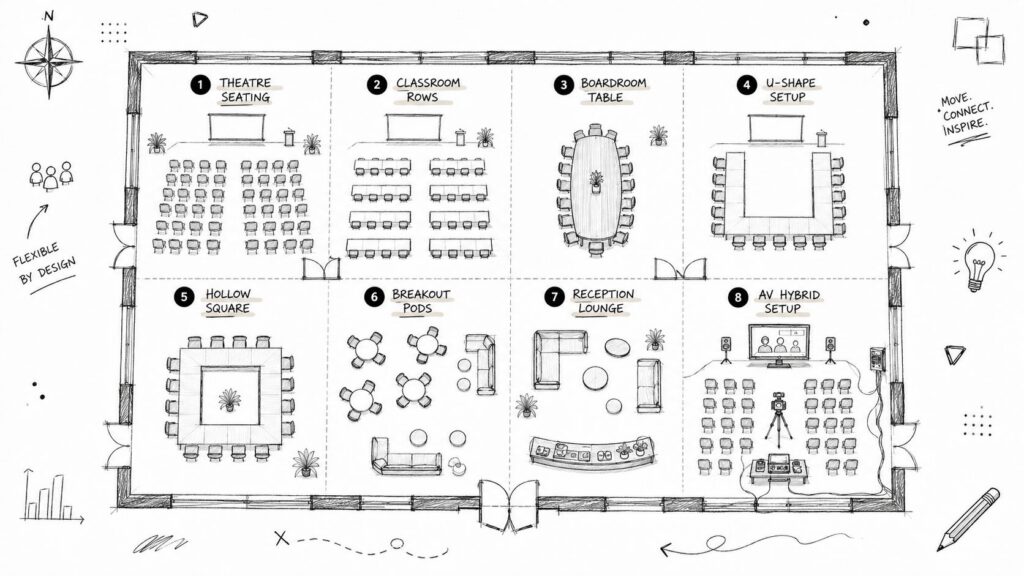
You're standing in a venue with a guest list in one hand and a rough floor plan in the other, trying to answer the question that decides whether the event feels polished or awkward. The chairs are rented, the AV is booked, and the caterer wants to know where the buffet belongs, but none of that matters if the conference room setup fights the way people meet. The right layout controls sightlines, movement, service, and how smoothly remote attendees can follow along, which is why modern planning has shifted toward right-sizing rooms for real use instead of forcing every event into a boardroom shape. In practice, that shift favors compact, collaboration-friendly rooms, because one workplace survey found 59% of meetings involve only two to three people, and occupancy data showed 80% of meetings happen in rooms designed for six people or fewer (workplace sizing and room usage data). If you're planning at a venue like Texas Old Town, the layout decision shapes everything from the first toast to the final cleanup, so use this as a practical playbook, not a theory lesson. For a broader event-planning baseline, how to plan corporate events is a useful companion read. Table of Contents 1. Banquet Style Seating 2. Cocktail/Standing Reception Layout 3. U-Shape Configuration 4. Hollow Square/Boardroom Layout 5. Cluster/Pod Seating Arrangement 6. Ceremony + Reception Hybrid Layout 7. Cabaret Style Theatre-in-the-Round 8. Amphitheater Style Outdoor Seating 8 Conference Room Layouts Comparison Execute Your Vision at Texas Old Town 1. Banquet Style Seating Banquet seating works when the event needs one clear focal point and a room full of people who still want to eat comfortably. At Texas Old Town, I'd use it for formal receptions in Tejas, Stone, or Sage, where rows of tables can face a stage, head table, or dance floor without turning the room into a maze. The setup feels familiar to guests, and it supports the kind of announcements, toasts, and plated service that can get messy in looser layouts. A practical banquet floor plan starts with the center aisle, not the tables. Leave it wide enough for entrances, speeches, and catering traffic, then build your rows around that spine so the room never feels blocked. The venue's 16-hour rental window gives you room to stage the setup early, and that matters because banquet layouts take longer to perfect than most planners expect, especially when you're aligning table lines with a podium or dance floor. Practical rule: Put the head table or speaker position perpendicular to the banquet rows so guests don't have to twist awkwardly to see it. For Texas Old Town events, I also like banquet seating when the beverage bar needs a defined location. That keeps the service flow cleaner, especially if the caterer is moving from the prep kitchen while guests are seated. The venue's included PA system and wireless microphone are worth using here, because a banquet room without clean audio turns every announcement into a room-wide lean-in. If you're planning for a guest count close to the hall's documented furniture capacity, check the venue page for event capacity planning at Texas Old Town and map your tables before rentals arrive. 2. Cocktail/Standing Reception Layout A cocktail layout is the right move when you want people moving, greeting, and re-grouping instead of staying planted at one chair for hours. It fits corporate networking, engagement-party mingling, rehearsal dinner openers, and pre-dinner social time in the Hill Country, especially when you want the room to feel open and energetic. I use it when the event is meant to start conversations, not suppress them with a rigid seating chart. The biggest mistake with standing receptions is overfurnishing the room. Too many high-tops create islands that cut off circulation, and too much seating turns the layout into a half-finished dinner. Keep clusters of two to three high-tops together so guests can talk without crowding the main flow, then push any extra seating to the perimeter where it supports older guests, parents, or anyone who needs a break. Because Texas Old Town gives you a full 16-hour rental window, it's smart to stage this layout during the morning and then fine-tune it as the venue light changes through the day. Early evening works especially well for Hill Country events, since the setting around the property becomes part of the experience rather than just a backdrop. I'd also separate appetizer stations from the beverage bar, because those two lines attract the same people at the same moment and can clog the room fast. Keep the transition cue obvious. A short announcement, a music change, or a staff member guiding guests toward dinner works better than assuming everyone will notice naturally. This layout pairs well with Texas Old Town's wireless microphone for brief welcomes or toasts, especially before the room shifts into a seated meal. If your event starts as a mixer and ends as a dinner, build that transition into the layout itself rather than treating it like an afterthought. For a practical scheduling aid, the venue's reception schedule template can help you time the handoff without making the night feel rushed. 3. U-Shape Configuration U-shape seating is a strong choice when the presenter needs eye contact, but the group still needs enough structure to stay focused. It works especially well for workshops, executive briefings, training sessions, and business roundtables in Sage or Stone, where you want everyone to feel involved without putting every person on the same level as a stage audience. The open center keeps attention on the presenter while preserving direct sightlines between participants. The advantage of this layout is also its weakness. If the U gets too wide, the people at the far ends feel disconnected, and if the open center gets too cramped, the presenter has nowhere to move. I keep the opening generous enough for Q&A, note delivery, and screen visibility, then place the podium or screen where it can be seen from every seat without forcing anyone to crane their neck.

Scroll to Top