Uncategorized

Day of Wedding Coordination: What It Is and Why You Need It

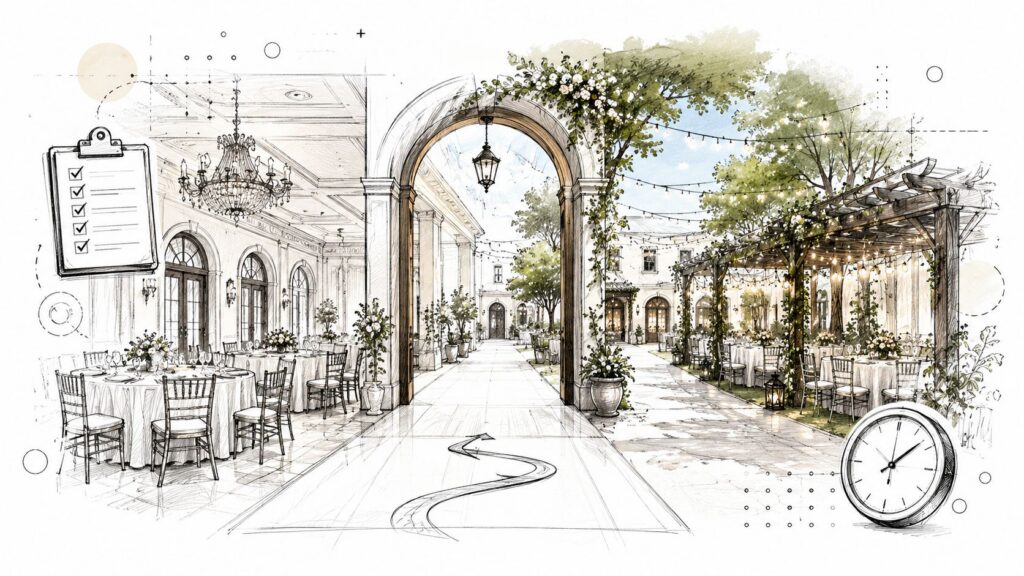
The most popular advice about day-of wedding coordination is also the most misleading: hire someone who shows up only on the wedding day. By then, many of the decisions that determine whether the day feels calm or chaotic should already be settled. Vendor access, ceremony cues, floor plans, transportation, photo timing, weather alternatives, and the handoff from venue staff to the couple all need an owner before guests arrive. A professional coordinator is brought in for the final execution phase, but that phase starts before the wedding day. The work is less glamorous than choosing flowers, yet it protects the parts guests experience, including whether the ceremony begins on time, whether the band can load in without blocking the caterer, and whether the couple gets to dinner instead of solving a missing-chair problem. Table of Contents What Day of Wedding Coordination Really Means The hidden transition phase Core Duties and Deliverables You Can Expect Before guests arrive During the celebration Sample Wedding Day Timeline for Texas Old Town A workable example Your Pre-Wedding Coordination Checklist Lock the documents first Build the cue and contingency files Prepare the people, not only the paperwork Cost Expectations and How to Choose a Coordinator Day-of Coordination Cost Factors Questions that reveal the real scope Frequently Asked Questions for Central Texas Couples What's the difference between a venue manager and a day-of coordinator? How does coordination change for an outdoor ceremony? What happens if the ceremony must move inside? Can a coordinator work with Texas Old Town's on-site manager? Do couples need day-of coordination if the venue includes support? What Day of Wedding Coordination Really Means Day-of coordination starts well before the wedding day. In practice, many coordinators begin 30 to 45 days before the event, gathering vendor details, reviewing contracts, building the master timeline, and confirming logistics, as explained in this day-of wedding coordinator FAQ. The label describes the service level, not the full workload. That early work matters at Central Texas venues such as Texas Old Town, where couples may have 16-hour venue access and indoor and outdoor spaces to coordinate. A venue team, caterer, bar company, florist, rental company, photographer, videographer, DJ or band, transportation provider, beauty professionals, and ceremony participants may all share the same schedule. Each can do their job well while still creating a conflict if nobody controls arrival order, setup space, sound checks, weather changes, or departures. The hidden transition phase The coordinator turns scattered information into an operating plan. That work typically includes: Vendor confirmation: Collecting arrival times, contact information, service commitments, power requirements, loading instructions, and departure expectations. Timeline construction: Scheduling the ceremony, first look, photography, meal service, speeches, dances, and send-off around actual setup and travel needs. Site logistics: Reviewing ceremony and reception locations, guest movement, parking, dressing areas, service entrances, indoor and outdoor options, and weather alternatives. Client handoff: Learning the couple's priorities, family dynamics, private moments, and decisions that should remain with them rather than a vendor. A shared timeline should reach key vendors 2 to 4 weeks before the event. That gives the team time to identify conflicts while changes are still practical. It also lets the coordinator test the plan against venue access, deliveries, setup windows, and the indoor or outdoor backup arrangement. Relatives, friends, and venue staff once absorbed much of this work informally. As weddings gained more vendors and tighter schedules, coordination became a distinct role. The coordinator does not replace the venue manager, caterer, or DJ. Instead, the coordinator connects their responsibilities so the couple is not managing calls and decisions during the final stretch. Practical rule: If the couple is still answering vendor questions, locating contracts, or deciding who gives the ceremony cue during the final month, the handoff is incomplete. Couples pay for coordination because many small decisions converge at once. The service reduces the chance that a missing detail, delayed delivery, or unclear cue reaches the couple during the celebration. Core Duties and Deliverables You Can Expect Day-of coordination is a document-heavy job before it becomes a visible event-day role. The coordinator turns contracts, venue rules, vendor arrival plans, and the couple's priorities into decisions that can be executed under pressure. Before guests arrive The coordinator builds the master timeline and tests it against venue access, vendor contracts, the ceremony plan, reception layout, and the indoor or outdoor setup. A useful timeline includes the work guests never see: who opens doors, where deliveries are staged, when the caterer enters the prep kitchen, when the photographer needs the couple, and who controls the ceremony microphone. Vendor sequencing creates its own risks. If the florist, rental team, caterer, entertainment, and photographer use one route, an arrival list will not prevent congestion. The coordinator assigns load-in windows, confirms service entrances, and keeps one team's equipment from blocking another team's setup. With 8 or more vendor teams, separate windows for load-in, sound check, preparation, and breakdown help keep the schedule workable. Protecting 10 to 15 minute buffers between moving parts also gives the team room to absorb delays without moving every later task. The coordinator should also prepare a contact sheet, escalation plan, and decision list. Vendors need to know which questions go to the coordinator, which choices remain with the couple, and what happens if weather changes the ceremony location. This hidden preparation is what lets the coordinator make a fast call during a Texas Old Town wedding without searching through messages or asking the couple to solve the problem. During the celebration Once guests arrive, the coordinator manages transitions that are easy to overlook but highly visible when they fail: Arrival and seating: Directing guests, wedding party members, and ushers away from active setup areas. Ceremony cueing: Confirming processional order, music, officiant readiness, microphone placement, and the start signal. Photo and cocktail flow: Keeping the couple's photo plan on schedule while directing guests to the next space. Reception cues: Calling introductions, first dance, parent dances, speeches, meal service, and open dancing. Problem solving: Taking vendor calls,
Photographic Venues in Austin: Top Picks for 2026

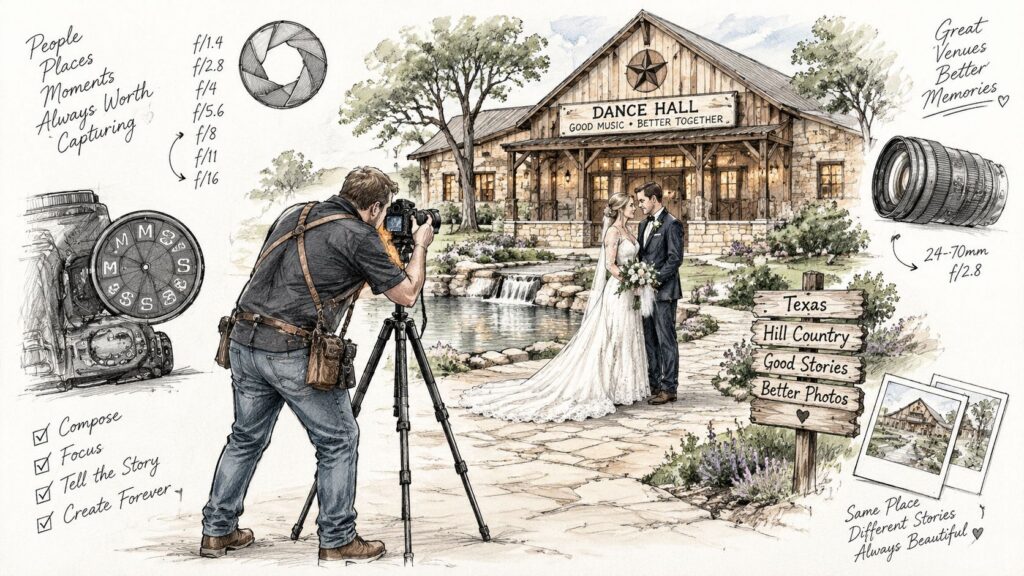
You've found a venue with beautiful oak trees, open lawns, or a dramatic Hill Country view. Then the practical questions arrive. Can you reserve the space for portraits? Will another group occupy the best background? What happens if the ceremony, family photos, and reception all need the same location? Those questions matter more than an Instagram-friendly backdrop. The most useful photographic venues in Austin give the photographer predictable access, workable light, room to move, and enough schedule flexibility to preserve the moments that happen between the formal events. Austin has the creative depth to support that approach. The city's commercial photography roots reach back to the daguerreotype era, and the Harry Ransom Center holds about 5 million prints and negatives, including Joseph Nicéphore Niépce's first photographic image and the Magnum Photos archives, as documented in the Austin Public Library's Photography Resources Guide. The local wedding market also supports serious visual coverage, with the 2024 Austin Round Rock market exceeding $467.3 million across 12,394 weddings, according to Austin Round Rock wedding market data. Table of Contents Why Private Venues Beat Public Parks for Event Photography The usability gap behind the scenery Why this matters on short timelines Texas Old Town's Four Distinct Halls and Their Photo Characteristics Matching the hall to the visual brief One campus, several backdrop types Camera Settings and Gear for Indoor and Outdoor Venue Scenarios Start with the scene, not the preset The kit I'd carry Full Wedding Day Shooting Workflow at Texas Old Town Morning preparation should establish the visual language Build transitions around real movement Solving Common Lighting Problems at Hill Country Venues Outdoor problems require positioning first Indoor spaces need color and motion control How 16-Hour Exclusive Access Improves Photo Quality and Timeline Flexibility A flexible timeline protects the important images Why Private Venues Beat Public Parks for Event Photography Public parks look like obvious choices for Austin portraits. Zilker Metropolitan Park, Auditorium Shores, Mayfield Park, Mt. Bonnell, and Zilker Botanical Garden offer recognizable scenery, and scenic locations can produce excellent engagement images. The problem appears when you try to use that scenery for a real event day rather than a short portrait session. Austin Parks and Recreation requires paid photo session permits for posed, portrait, or commercial photography at high-use public locations, according to its special events policies and procedures. The standard permitted session lasts 2 hours, and booking is available only 4 to 30 days ahead, so a couple planning months in advance may still face an inconvenient reservation window. Those restrictions are manageable for a contained engagement session. They're much harder to reconcile with a wedding timeline that includes preparation, a first look, family formals, wedding party photos, couple portraits, and weather delays. The usability gap behind the scenery A public park also remains a shared space. Runners, tourists, other portrait sessions, private rentals, and changing light can all affect the frame. Props may need approval, paths may be crowded, and the most attractive overlook might be unavailable when your timeline reaches it. Practical rule: Treat a public park as a location for a planned portrait session, not as an automatically available wedding venue. A private venue changes the operating conditions. Exclusive access means the photographer can select portrait areas before guests arrive, return to a background later, and work with the venue manager when weather or setup changes the plan. On-site management also reduces the chance that the couple, planner, or photographer has to solve access and vendor conflicts in the middle of the event. Why this matters on short timelines A public permit can't solve every event-day problem. It doesn't create a private dressing area, protect a ceremony schedule, provide a backup indoor location, or guarantee that a group won't cross behind the couple. Private venues generally cost more than a simple public backdrop, but the comparison should include time certainty, exclusive use, weather options, and operational support, not scenery alone. For couples choosing among photographic venues in Austin, the better question is not “Which place looks best in a still image?” It's “Can this property support every image we need without moving the entire event?” Texas Old Town's Four Distinct Halls and Their Photo Characteristics Texas Old Town places four private halls on one 55-acre Hill Country property. The halls serve different guest counts and visual moods, from Redbud for up to 150 guests to Tejas for up to 320, while Sage and Stone each accommodate up to 300 guests. Those capacities and the venue's published hall descriptions create meaningful differences in how a photographer handles group size, ceremony placement, and background separation. Matching the hall to the visual brief Tejas has an authentic Texas country dance hall character, with handcrafted pine tables that support a warm, textural look. For a large wedding, its capacity gives the photographer room to document a full dance floor and broad guest reactions, but the rustic surfaces can also reflect or absorb light differently from a modern white interior. I'd scout the ceremony and head-table angles before guests enter, especially if the couple wants environmental portraits that show the hall's character rather than flattening it with direct flash. Sage is more secluded near the grand entrance. That positioning can make arrivals, first looks, and quieter couple portraits feel separate from the busiest guest routes. A photographer can use the transition from exterior grounds to hall interiors to create visual variety without loading the timeline with a drive to another location. Stone offers upscale finishes and can suit couples who want cleaner, more polished architectural frames. The hall's formal surfaces call for careful attention to reflections, skin tones, and the placement of uplighting or DJ fixtures. Texas Old Town also identifies Stone Hall as a location where photoshoots may be available, subject to scheduling and confirmation, so couples should ask the venue about portrait access rather than assume availability. For a closer look at one hall's visual details, the Tejas Hall gallery is more useful than choosing from capacity alone. Couples planning

Affordable All Inclusive Wedding Venues: 2026 Guide

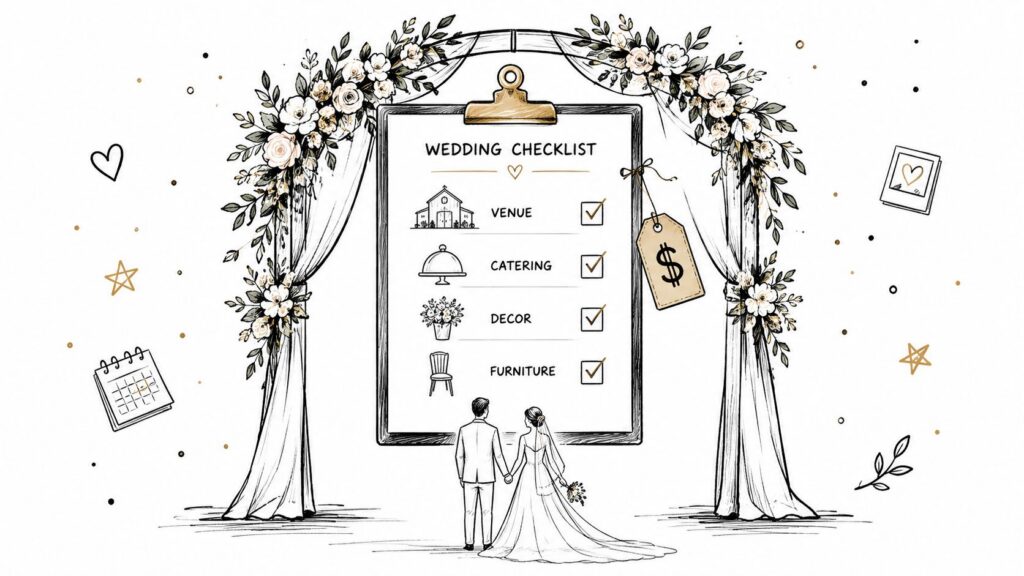
The Knot's 2026 Real Weddings Study puts the average U.S. wedding venue cost at $12,900, while Zola reports an average of $8,573, with a typical range of $6,900 to $10,300 (The Knot's venue-cost data, Zola's wedding cost guide). That gap tells you exactly why the cheapest venue rental rarely produces the cheapest wedding. The question isn't, “What's the site fee?” It's, “What will this venue cost after setup, furniture, staffing, cleanup, service charges, and required extras?” For Central Texas couples, affordable all inclusive wedding venues should make the final price easier to understand, not merely make the first quote look attractive. A venue that bundles essential services can be worth more than a low-cost space that leaves you coordinating every logistical detail yourself. Table of Contents What Affordable Really Means for Wedding Venues Read the quote as a complete product Use one comparison standard Building a True Total-Cost Wedding Budget Step one, isolate the venue line Step two, convert everything to an all-in number What Genuine All-Inclusive Packages Actually Cover The essentials that save real money Separate useful inclusions from marketing filler Texas Old Town as a Transparent Pricing Example What the venue absorbs Why access and vendors change the calculation Red Flags That Turn Affordable Quotes Into Expensive Mistakes Five contract warnings deserve immediate attention Flexibility is part of affordability Your Booking Timeline and Negotiation Playbook Research and shortlist Compare before you negotiate What Affordable Really Means for Wedding Venues A rustic barn rental may appear below $3,000, while luxury private estates and metropolitan ballrooms can reach $20,000 to $30,000 or more before catering, according to industry pricing summarized by The Knot. Those figures describe different levels of service. The actual question isn't, “What's the site fee?” Ask instead, “What will this venue cost after setup, furniture, staffing, cleanup, service charges, overtime, and required extras?” For Central Texas couples, affordability starts with total-package value. Texas Old Town is a useful case study because transparent pricing makes it easier to identify what the quoted package covers and what could still land on the final invoice. A low rental fee can become expensive once you add tables, chairs, ceremony seating, setup, breakdown, cleaning, venue staff, sound equipment, or a private dressing suite. A basic rental buys access to a space for a defined period. It does not automatically include the labor and logistics needed to run a wedding. Those omissions create the hidden cost stack that makes an apparently affordable venue more expensive than a higher-priced package with clearer inclusions. Read the quote as a complete product A venue quote should answer four questions immediately: What do we receive? List furniture, access hours, ceremony spaces, staff, cleanup, and equipment. What must we purchase separately? Identify catering, bar service, linens, rentals, insurance, and labor. Which charges depend on guest count? Separate per-person pricing from fixed venue expenses. Which charges depend on the date? Ask about peak Saturdays, seasonal pricing, and overtime. Venue spending has risen sharply over time. One industry summary reports increases since earlier years, with couples spending substantial amounts on the venue alone (venue-cost analysis from Pix). The exact benchmark matters less than the planning lesson: predictable bundled pricing protects couples from a series of late additions. Use one comparison standard Industry models place venues at roughly 24% to 40% of total wedding spending, while broader wedding budgets may run $34,000 to $36,000. Zola's average places the venue line at about 17% of the total wedding budget, illustrating how different budget frameworks produce different benchmarks (Zola's wedding cost guide). Use your own all-in calculation. Add every venue-related charge, then divide the result by the services and access included. A higher quote can be the affordable choice when it includes labor, furniture, cleanup, and logistics that another venue bills separately. Planner's rule: If two venues don't include the same services, you aren't comparing prices. You're comparing incomplete quotes. Building a True Total-Cost Wedding Budget Start your comparison with a spreadsheet, not a tour schedule. Give each venue its own column and list every charge that could reach the final invoice. Enter the quoted price, then separate required fees, selected upgrades, taxes, gratuity, and a contingency line. Step one, isolate the venue line Record the site fee, package fee, date category, access window, guest minimum, and maximum capacity. Confirm whether the ceremony and reception stay in one space or require a room change. A short access window can trigger extra labor or overtime, even when the starting quote looks affordable. Check every charge outside the headline price. Service charges, setup fees, overtime, and administrative fees can add 15% to 25% to the final bill, according to all-inclusive venue fee guidance from Weymouth Hill. Treat that range as a prompt to investigate the contract, not as an automatic fee at every venue. Fee Category Typical Cost Range Included at All-Inclusive Venues Service charges and administrative fees 15% to 25% of the final bill when applied as a fee stack Sometimes, verify in writing Setup and breakdown labor Varies by venue and scope Often included, but confirm who handles furniture and décor Overtime Varies by contract Included only when the access window explicitly covers it Corkage and bar-related fees Varies by beverage policy May be included, waived, or charged separately Cake-cutting Varies by venue Ask whether outside cake service is included Vendor meals Varies by caterer and contract Confirm before final guest counts Required insurance Varies by policy Do not assume it is included Step two, convert everything to an all-in number Use this formula: Quoted package or site fee + required charges + selected add-ons + tax and gratuity not already included = comparable venue total. Divide that total by your expected guest count, then repeat the calculation with lower and higher guest counts. The comparison exposes per-person minimums and shows whether the quote still works if your invitation list changes. A $5,000 site-fee venue can cost more than a $9,000 all-inclusive package after rentals, labor, catering, bar service, and cleanup. The

7 Bed and Breakfast in the Hill Country TX

You're at the part of the planning process where the venue is set, the invitation has gone out, and the question is simple. Where should everyone sleep after the celebration at Texas Old Town in Kyle? For couples, wedding guests, and weekend travelers, the right bed and breakfast in the Hill Country TX is less about charm alone and more about timing, breakfast style, room layout, group logistics, and whether you can get back to the Austin–San Antonio corridor without stress. Exact driving distances and current rates should still be confirmed before booking, but the stay experience itself already tells you a lot about who each property suits best. The Hill Country lodging market is active but fragmented. One tourism dataset lists 101 B&B accommodations out of 1,031 total accommodations in the region, while Booking.com shows 145 bookable B&Bs and Tripadvisor lists 199 properties matching B&B-related filters, which tells you B&Bs are present but not dominant in the overnight mix, according to the Texas Hill Country tourism statistics. That matters for event trips, because the best choice is usually the property that fits your schedule and group needs, not the prettiest photo. Table of Contents Sage Hill Inn & Spa Best for couples who want everything in one place Blair House Inn A better match for culinary weekends than rushed event travel BellaVida Bed & Breakfast & Retreat Center The best fit for coordinated group logistics Kuebler Waldrip Haus Bed & Breakfast Historic setting with real group utility Hoffman Haus The right choice when breakfast is part of the experience Magnolia House Bed & Breakfast Small scale, strong hosting, limited flexibility Cotton Gin Village Best for couples who want privacy more than interaction Top 7 Hill Country, TX Bed & Breakfast Comparison Book the Right Base Before the Weekend Fills Sage Hill Inn & Spa Sage Hill Inn & Spa is the clear pick when you want a resort-style B&B experience without giving up access to Kyle, Buda, San Marcos, or South Austin. The property sits on 88 private acres and adds hiking trails, a pool, a 14-person hot tub, a full-service spa, and an on-property dining room, so guests can arrive, settle in, and stay on site. Its breakfast setup is an expanded continental breakfast plus a $75 daily dining credit, which makes it especially useful for couples who want a polished weekend rather than a choose-your-own-adventure stay. For Texas Old Town guests, the travel and lodging guidance makes this kind of nearby, all-in-one stay a practical fit. Best for couples who want everything in one place This is the strongest option for VIPs, anniversary trips, and couples attending a wedding who want the lodging to feel like part of the weekend instead of just a bed. The dining credit model works well if you want a sit-down dinner on property, but it's a poor fit if you already know you'll eat every meal off site. That's the trade-off here. Practical rule: Choose Sage Hill when you want spa time, a meal on property, and a calmer pace between the rehearsal dinner and the reception. Two things to check before you book. Many weekends require a two-night minimum, and the dining room doesn't always offer late seating. If your group is coming in after work or you're leaving early the next morning, confirm the arrival window and breakfast timing directly. Best use case: Wedding weekend base for couples and top-tier guests Breakfast style: Expanded continental breakfast Group fit: Good for pairs, not ideal for large family blocks Booking caution: Verify dinner hours and minimum-stay rules Blair House Inn Blair House Inn is the right choice when the stay itself needs to feel curated. Set in Wimberley, it combines suites and cottages with an on-site day spa, optional multi-course dinners on select nights, lunch offerings, and a cooking school. That combination makes it a strong fit for couples who care as much about the evening meal as the room, especially when they want a quiet, wooded setting rather than a busier town-center stay. A better match for culinary weekends than rushed event travel If your priority is a romantic getaway, Blair House Inn delivers the most complete dining-and-spa package in this group. Park once, check in, and let the property handle the pace of the weekend. That setup works well for wine-trail visitors and for guests who want to keep the car parked while they move between spa time, dinner, and a relaxed morning. The downside is simple. Dinner service runs on specific seatings, so you can't treat it like a flexible restaurant. If your wedding schedule is still in flux or your group likes late arrivals, check availability before you commit. Keep this property for weekends where the stay itself is the destination. Best use case: Romantic escape with spa and culinary focus Breakfast style: Included, with a polished inn feel Group fit: Better for couples than for wedding-party blocks Booking caution: Confirm dinner seatings before you plan the night around them BellaVida Bed & Breakfast & Retreat Center For groups that need one place to stay, BellaVida makes the decision easy. It functions as a hosted B&B and a retreat center, so it fits families, bridal parties, and small wedding groups that want to stay under one roof instead of scattering across separate rooms around town. Breakfast is included, and the property adds a coffee and tea bar, a guest lounge, and owner-operated service that can help with local planning. The best fit for coordinated group logistics Choose BellaVida when the weekend depends on shared logistics, not just a nice room. Retreat pricing and per-person rates make the property easier to compare for multi-room stays, and the optional kitchen access guidelines give groups a way to coordinate meals and downtime. That setup works well for bridesmaids, siblings, and out-of-town relatives who need a central place to meet between events. It also works well for guests heading to Texas Old Town or other Kyle-area events, because the group

Cowboy Themed Event Space Guide for Hill Country Weddings

You're standing on a Hill Country property with your phone full of screenshots, trying to decide whether the place feels like a real western wedding or just a barn with a few lanterns hung up for the tour. That's the right instinct. A cowboy themed event space only works when the mood, the movement, and the guest experience line up, not when the decor is trying too hard. The best version feels unhurried and grounded. Guests hear boots on wood, music carrying cleanly from the dance floor, and people talking without shouting over a bad sound system. The worst version looks fine in photos and falls apart the second the weather shifts, the vendor team arrives, or dinner service starts. Table of Contents What a Cowboy Themed Event Space Feels Like Defining the Rustic Hideaway Cabin Look What the room needs to say Structural features that matter more than Pinterest Matching Hill Country Halls to the Cowboy Vibe How the halls read on the ground Styling Checklist for a True Cabin Hideaway Entry, tables, bar, and light What to skip Ceremony and Reception Layouts That Flow Build the day in layers Vendors, Photography Spots, and a 16-Hour Day What Makes the Day Easier Map the 16-hour window early Weather and Backup Plans for Hill Country Events Your Pre-Tour Planning Checklist Bring this list to every tour What a Cowboy Themed Event Space Feels Like A true western setting doesn't announce itself with gimmicks. It greets people with lantern light, warm wood, open air, and enough breathing room that nobody feels boxed into a theme. Guests settle faster in a space like that, and the room feels confident without trying to prove anything. The cabin-hideaway version of this style is quieter than the usual rodeo look. It relies on texture, not novelty. Oak trees, pine tables, stone, soft lighting, and a room that lets the Hill Country do most of the talking set the tone. That is why the property matters more than the props. A venue like Texas Old Town's western-themed venues works when the atmosphere holds up in real use, not just in one styled corner. Guests remember the way the ceremony space feels at dusk, how the room carries sound, and how easily they move from cocktail hour to dinner without confusion. Practical rule: If the space still feels western after the decor is packed away, you have the right foundation. Skip the cowboy look built on overdone signage, plastic props, or too many staged details. The goal is a grounded, easy setting where the space and the layout do the heavy lifting. That is what guests feel, even if they cannot name it. Defining the Rustic Hideaway Cabin Look “Rustic hideaway cabin” is a design language, not a pile of decorations. The look is built on reclaimed wood, wrought iron, leather, wool, vintage ranch details, and unpolished stone or masonry. These materials create warmth and texture without making the venue feel staged. The result should feel collected, not manufactured. What the room needs to say Start with surfaces. Pine, stone, metal, and worn leather do the heavy lifting because they read as authentic even when the rest of the styling stays simple. Mason-jar lighting, wagon-wheel references, and ranch signage can support the look, but they should stay in the background. If the venue needs a stack of extra rentals just to look believable, the base space is weak. Then check the functional features. A room that is climate-controlled, has dressing suites, includes a built-in bar, and offers a clean outdoor ceremony site already gives you the bones of the vibe. That matters because a venue can photograph western and still fail western in practice. Guests do not care how rustic the walls looked if they were sweating through dinner or waiting in an awkward hallway. The test is simple. Ask whether the venue works before styling begins. If the answer is yes, your decor becomes an accent instead of a rescue mission. If the answer is no, the design budget gets eaten up fixing problems that should have been handled by the space itself. For a styling reference that is useful, this rustic western decor guide from Texas Old Town matches real event flow better than a generic mood board does. Structural features that matter more than Pinterest Climate control keeps the room usable in Hill Country weather. On-site dressing suites protect the timeline and keep the wedding party out of guest traffic. A built-in bar keeps service tidy instead of scattered across the hall. An outdoor ceremony area gives you the western backdrop without making the whole event depend on weather. Matching Hill Country Halls to the Cowboy Vibe The four-hall layout at Texas Old Town is a practical way to judge cowboy style because each room handles the mood differently. Guest count, privacy, and finish level shape the experience more than most couples expect. One hall fits a rougher dance-hall feel, another works better as a hideaway, and another lands in polished-rustic territory. How the halls read on the ground Tejas is the strongest fit for a larger western wedding because it reads like a true Texas country dance hall, with handcrafted pine tables and space for up to 320 guests. Choose it when you want movement, noise, and a crowd that can spread out without the room losing its energy. Sage also holds up to 300 guests, but its secluded placement near the grand entrance changes the experience. It suits couples who want a private arrival and a little more ceremony before the reception opens up. Stone, also up to 300, leans more polished-rustic because of its upscale finishes. If your version of cowboy is cleaner and more refined than rugged, this is the better match. Redbud is the intimate option at up to 150 guests, and it comes closest to a real cabin-hideaway mood. Smaller guest counts work here because the room feels deliberate instead of empty. Hall Max Guests Style Best

Western Themed Venues: A Practical Planning Guide

You're standing on a Hill Country property with a glass of iced tea in one hand and a venue brochure in the other, trying to decide whether the place feels ready for your event or just dressed up for the tour. The tables look right. The ceremony lawn looks great in photos. Then you start asking key questions, and that's where the difference between rustic and run-down becomes obvious. Western themed venues are selling more than a look. They're selling a setting that has to hold up under heat, crowds, vendors, grandparents, kids, music, food service, and the kind of timeline that gets messy fast if the property isn't built for it. If you're booking a wedding, quinceañera, corporate offsite, or milestone party, the details that matter most are the ones nobody puts on a mood board. Table of Contents Why Western Themed Venues Need a Second Look Rustic is not the same as unfinished Who should care most The Market Context Buyers Should Understand Outdoor space is not a bonus anymore What Climate Control Actually Means in a Western Venue The four layers that matter The question to ask on tour Why Climate Control Matters for Weddings and Special Events Comfort affects the whole timeline AV and flooring are easy to forget until they fail The Buyer Checklist for Climate, Layout, and Logistics Climate redundancy and setpoints Runtime, access, and vendor freedom Accessibility and cleanup Matching Ceremony Format to Venue Layout Indoor ceremonies work when certainty matters Covered outdoor spaces split the difference Open-air lawns are for specific guest profiles How Western Venues Scale Across Event Types Different events need different room behavior Adaptability beats rigid styling The Real Signal of a Serious Western Venue Why Western Themed Venues Need a Second Look A couple tours a Hill Country property and falls for the pine tables, the lanterns, and the ceremony lawn. That reaction is normal. The mistake is stopping there, because the prettiest room in the brochure is not always the room that can handle your guest count, your weather, your timeline, or your vendor team without drama. Western themed venues work when the theme supports the event, not when the theme becomes a liability. Couples, quinceañera families, corporate planners, and milestone hosts all run into the same question in different ways: can the property deliver the event, or does it only photograph well? Rustic is not the same as unfinished People use “rustic” as if it automatically means charming. Sometimes it does. Sometimes it means poor circulation, awkward load-in, no backup ceremony space, and a staff that hopes the weather cooperates. A serious western venue solves problems before guests see them. The reception hall stays comfortable, the ceremony plan has a backup, the vendor path is clear, and cleanup doesn't hijack the next morning. That's not a luxury list. It's the difference between a smooth event and a room full of people asking why the music cut out or why they're sweating through dinner. Who should care most Everyone should care, but the pain points differ. A wedding couple worries about comfort, photos, and the ceremony backup. A quinceañera family worries about grandparents, court entrances, dancing, and vendor coordination. Corporate planners care about presentation, audio, branding, and a schedule that doesn't unravel when one session runs long. Milestone-event hosts just want the room to feel easy, not chaotic. Practical rule: If a venue keeps talking about “vibe” but avoids questions about loading, temperature, and contingency plans, keep walking. The right lens is simple. Theme gets people interested. Operations decide whether they stay happy. That's the standard you should use on every tour. The Market Context Buyers Should Understand Western themed venues are not competing in a cute little niche. They sit inside a crowded event market where operators win bookings by being flexible, not just photogenic. Industry compilations show a large global venue market with North America holding a major share, and that matters because buyers can choose from properties that do much more than one type of celebration Zipdo's event venue industry statistics. That same compilation points to roughly 100,000 event venues in the U.S., with weddings leading bookings, followed by corporate meetings and conferences, then social gatherings Zipdo's event venue industry statistics. The booking mix tells you what strong western properties already know. They need multiple halls, indoor and outdoor options, and vendor rules that let a planner build the event around the guest list instead of forcing every group into one rigid format. Outdoor space is not a bonus anymore Outdoor demand changed after the pandemic, and buyers should treat that as a permanent shift in expectations. Venue compilations reported a sharp increase in interest for outdoor spaces, which is why so many Hill Country properties pair ceremony lawns with climate-controlled reception halls Zipdo's event venue industry statistics. Guests want the open-air look, but they do not want dinner service, speeches, or dancing left at the mercy of the weather. Western themed venues also ride a broader experiential trend. A 2025 industry roundup reported a jump in interest for ranch vacations and cowboy-core activities, along with stronger demand for ranch stays, cowboy-core experiences, and horseback-riding getaways Cincinnati.com press release. That does not mean every venue should turn itself into a tourist attraction. It does mean guests are paying for settings that feel immersive and deliberate, not just a decorated room with a western sign on the wall. Buyers should expect serious western venues to compete like mainstream event real estate, because that is what they are. What Climate Control Actually Means in a Western Venue Climate control is not a wall thermostat and a polite promise. In a western venue, it is the system that keeps guests comfortable while the property still looks like a ranch, a barn, or a Hill Country retreat. That matters because these venues often mix open-air character with enclosed reception space. A tent gives atmosphere. A house gives control. A good venue takes the look of the first

10 Engagement Photo Shoots at Texas Old Town for 2026

Picture your perfect moment in the Texas Hill Country. Your engagement photos aren't just a box to check, they're the first visual chapter of your wedding story, and for Central Texas couples, the setting matters as much as the pose. Texas Old Town gives you a rare mix of 55 acres of Hill Country scenery, water features, streams, and four different venue styles in one property, so the same session can feel natural, polished, and personal without bouncing between locations. That matters because engagement photo shoots have become mainstream, not niche, with 67.5% of engaged couples planning one and another source estimating 77% of couples have engagement photos taken, plus search interest that keeps climbing as couples look for location-rich sessions (engagement photo trend facts). If you want inspiration from a venue that already understands Texas weddings, start with the venue's own engagement photo locations and keep the whole session focused on one place that can carry your story from wide scenic frames to intimate portraits. For a style reference beyond the venue itself, couples also like seeing how local art can echo the same Texas feeling, including Jessie's Home Texas art collection. Table of Contents 1. Hill Country Landscape & Architecture Shoot 2. Rustic Barn & Dance Hall Backdrop Shoot Use the hall like a real room, not a stage set 3. Upscale Indoor Venue Elegance Shoot Build the session around light, not just décor 4. Intimate Garden & Outdoor Ceremony Site Shoot Make the ceremony space work like a story arc 5. Seasonal & Wildflower Engagement Shoot Match the outfit to the season, not just the trend 6. Couple's Story & Lifestyle Engagement Shoot Build the gallery around real habits and shared routines 7. Proposal & Engagement Announcement Shoot Capture the reaction before the posing starts 8. Bridal Portrait & Individual Glamour Shoot Give the portrait enough time to breathe 9. Themed & Creative Concept Engagement Shoot Make the concept concrete before anyone arrives 10. Extended Family & Group Engagement Celebration Shoot Organize people by grouping, not by mood Top 10 Engagement Shoot Styles Comparison Book Your Unforgettable Engagement Shoot at Texas Old Town 1. Hill Country Landscape & Architecture Shoot Texas Old Town works best when you treat the property like a complete visual system, not a single backdrop. The Hill Country, the four halls, and the water features all give you contrast in one session, which is exactly what save-the-dates and wedding websites need when you want the images to feel cohesive without being repetitive. The strongest frames here usually come from mixing wide environmental shots with medium portraits and a few close details. Tejas Hall's rustic exterior can anchor a classic Texas look, while the outdoor ceremony site gives you the open-air depth that makes a couple stand out instead of disappear into the background. The streams and manicured edges help too, because reflective water and texture in the foreground make the composition feel layered instead of flat. Practical rule: let the venue do some of the storytelling for you. If every frame is a tight close-up, you lose the sense that this is your wedding place, not just a pretty field. The timing matters more here than people expect. Golden hour, either early morning or late afternoon, keeps the property soft and flattering, and it's the safest way to avoid harsh shadows on wood, stone, and skin. A venue walk-through before the session helps the photographer pick out the exact angles where architecture and surroundings work together, instead of fighting each other. If you're planning a wedding at Texas Old Town, this is the session style that gives you the cleanest transition from announcement cards to website banners. It feels grounded, it feels local, and it makes the venue part of the relationship story instead of a separate booking detail. 2. Rustic Barn & Dance Hall Backdrop Shoot Tejas Hall gives you a very specific kind of Texas character, and that's the point. The handcrafted pine tables, wood tones, and dance-hall atmosphere make the couple look like they belong in the space, not like they were dropped into it for a quick pose. When this style works, it works because the clothes and the room speak the same language. Jewel tones, warm neutrals, crisp white shirts, and texture-heavy fabrics all sit well against the hall's rustic surfaces, while something too shiny or too modern can look disconnected. If you want boots, hats, or a vintage Texas prop, use it with restraint so the hall still feels elegant instead of costume-heavy. Use the hall like a real room, not a stage set The best indoor dance-hall shots usually happen in natural light before the space gets busy with event setup. That lets windows do more of the work, which is important because indoor engagement photo shoots can flatten fast when the light is too even or too dim. The long tables and open floor also give you movement options, so the photographer can capture walking frames, seated portraits, and a few details without making the session feel repetitive. A useful scheduling habit is to photograph the hall after the venue has been prepared but before anything starts crowding the space. That keeps the composition clean and gives you room to use the architecture as a frame rather than a distraction. For couples who want a distinctly country or western feel, the venue's barn wedding style context helps reinforce the look without needing extra styling tricks. The biggest mistake here is over-posing. Rustic interiors already carry a lot of visual energy, so the couple doesn't need to act out every frame. A calm walk, a hand on the table, or a quiet glance across the room usually photographs better than forced movement. 3. Upscale Indoor Venue Elegance Shoot Stone Hall gives engagement photography a more polished tone, which is useful if your wedding plans lean formal or modern. The neutral palette, refined finishes, and indoor comfort mean the couple stays the focus, and the room

Event Planning Austin TX: Your 2026 Expert Guide

You're probably juggling a venue search, a guest list, and a calendar that's already filling up faster than you expected. That's normal in Austin. This market rewards people who move early, stay organized, and make decisions with the full logistics picture in mind, because the city's event economy is big, busy, and used to serious scale, from SXSW 2023's 425,000 attendees and $485 million economic impact to the 2023 Austin City Limits Festival's 350,000 attendees and $345 million impact (Austin events industry statistics). If you're trying to pull together a wedding, corporate offsite, quinceañera, or milestone party, the pressure usually isn't about one big decision. It's about a dozen small ones that all affect each other, like timing, guest flow, parking, vendor access, and how much control you have once the day starts. For a helpful parallel on managing a fast-moving launch-style event, the effective flash sale event guide is a useful reminder that tight timelines work best when the plan is simple, measurable, and locked down early. Table of Contents Your Austin Event Planning Journey Begins Here Start with the event's real objective Think like a planner, not a browser The Austin Event Planning Timeline From 18 Months to Day-Of Vision phase, 12 to 18 months out Foundation phase, 6 to 9 months out Details phase, 3 to 6 months out Finalization phase, 30 to 90 days out Execution phase, week-of Building a Realistic Budget for Your Central Texas Event Build the budget from the venue outward Know where flexibility saves money Choosing Your Venue and Assembling Your Austin Vendor Team What to ask on a venue walkthrough Build a vendor team that can actually work together Watch the contract language Navigating Austin Permits and Planning for Contingencies Check permissions before you lock the date Build a weather and access backup plan Final Rehearsals and Flawless Day-Of Coordination What to confirm before guests arrive The day-of checklist that keeps events calm Protect the last hour before the event starts Your Austin Event Planning Journey Begins Here Successful event planning Austin TX work starts with operations. The creative pieces matter, but the primary task is to match guest flow, vendor timing, weather backup plans, and site rules to the way Austin events typically unfold. In a market with busy calendars and high guest movement, the details around access, load-in, parking, and teardown are what protect the experience. Start with the event's real objective The cleanest plans begin with a single question, what does success look like for this event? A wedding may prioritize flow, food, and photos. A corporate event may care more about timing, breakout space, and sound. A quinceañera may need a strong ceremony-to-reception transition and room for family traditions to land without feeling rushed. Practical rule: if you can't explain the event's purpose in one sentence, you're not ready to book vendors yet. That clarity also helps you make better choices in Austin, where a polished venue can still create problems if it does not fit the headcount, setup schedule, or service style. A room that looks right in a gallery may be tight once catering stations, photo areas, and guest circulation are all in place. The same is true for outdoor space, because shade, wind, and heat can change how long people stay in one area and how smoothly the event moves. Think like a planner, not a browser Good planning starts by sizing the event accurately, then building decisions from there. A venue that looks perfect online can fail you if it can't support the guest count, caterer workflow, or parking pattern you need. A solid checklist makes those trade-offs visible before contracts are signed, which saves stress later. If you want a local benchmark for how structured planning should look, UT Austin's event checklist is a smart model, and Texas Old Town's event planning timeline shows how a venue can turn that logic into a practical sequence for real-world use. Some venues also create breathing room through extended rental windows, which helps spread out setup, vendor arrival, and cleanup instead of forcing everything into a rushed block. That matters in Austin, where a late vendor arrival or a parking delay can ripple through the entire day. The same planning mindset applies to alcohol service. If your event includes BYOB, the policy has to be handled with care, because guest safety, staff supervision, and clear check-in procedures all matter. A loose approach creates risk fast, especially when the schedule is already tight. A good example is an effective flash sale event guide, which shows how tight timing and clean execution shape the result. The setting is different, but the lesson is the same, the plan has to account for pressure points before the day begins. That mindset keeps an Austin event from feeling improvised. The earlier you define the goal, the easier every later decision becomes. The Austin Event Planning Timeline From 18 Months to Day-Of Vision phase, 12 to 18 months out This is the time to define the event's purpose, guest count, and feel. That sounds basic, but it's the step people skip when they're excited about venues and décor. The result is usually a mismatched space or a budget that doesn't fit the actual event. UT Austin's planning checklist recommends estimating attendance early so you can reserve an adequate facility and project all expenses before the rest of the planning starts (UT Austin planning checklist). That's not bureaucratic advice, it's the foundation of a workable plan. If the headcount is vague, everything else stays vague too. Foundation phase, 6 to 9 months out This is the booking window for the pieces that are hardest to replace. Secure the venue, anchor vendors, and any service providers tied to the event's timing or format. In Austin, delays become costly as popular dates disappear quickly and shortlists shrink fast. A good planner also checks the vendor policy at this stage. Some events need a fully coordinated package, while others work better with more flexibility.

The Ultimate Indoor Outdoor Event Space Guide

You're six weeks out, the guest list is finally locked, and the forecast just changed from clear skies to thunderstorms. That's the moment everyone finds out whether the venue was built for an indoor outdoor event space experience, or whether the marketing photos were doing all the heavy lifting. The difference is brutal on event day, because guests don't care how pretty the lawn looked at noon if the reception turns into a scramble by 4 p.m. A venue that can absorb a weather shift, keep vendors moving, and preserve the flow of the day is worth more than a prettier view with no backup. That's the operational reality couples, families, and corporate planners need to think about. It's also why the smartest buyers don't just ask, “Does it have indoor and outdoor areas?” They ask, “Can the whole event still work if the weather changes, the timeline compresses, or the service team needs to flip spaces fast?” Table of Contents Why Indoor Outdoor Event Spaces Are Winning Over Single-Setting Venues Flexibility beats scenic risk Why event expectations changed What Actually Makes a Venue Indoor Outdoor Look for transition points, not just doors Check whether the operational systems match the layout Red flags that should stop you Balancing Flexibility and Complexity in Indoor-Outdoor Events Control is the real advantage Duplication is the price you pay Budget, style, and risk tolerance decide the fit Your Decision Framework for Choosing the Right Venue Start with capacity, then pressure-test circulation Ask the vendor questions that expose the real operation Score venues on five real criteria Use your event type to decide what matters most Technical Requirements That Make or Break Indoor Outdoor Events Space standards are the starting point Structural load and accessibility are not optional Sound, power, and weather protection decide usability How Texas Old Town Solves Common Indoor Outdoor Event Challenges The logistics are built into the rental model Flexible spaces make the backup plan real Vendor freedom matters more than people admit Your Action Plan for Booking and Planning an Indoor Outdoor Event Book with the flow in mind Coordinate vendors as if the event will shift Use the site visit to eliminate doubt Why Indoor Outdoor Event Spaces Are Winning Over Single-Setting Venues At 4 p.m., the ceremony chairs are lined up outside, the florist is doing final touches, and then the sky turns ugly. I've watched that exact moment expose weak venues fast. The places that win are the ones where the indoor room isn't an afterthought, but a true fallback that can carry the full event without guests feeling like they've been downgraded. That's indoor outdoor event space bookings keep pulling ahead of one-setting venues. Planners and clients want control, not luck. The global venue map makes that pressure easy to understand, because by the end of 2024 there were 1,530 venues worldwide with at least 5,000 square meters of indoor exhibition space, totaling 44.3 million square meters, and only 81 venues crossed the 100,000 square meter mark, according to the UFI World Map of Venues 2025. Scale is rare, so flexibility matters even more. Flexibility beats scenic risk The modern client is not booking a single photo moment. They're booking a full day that has to survive weather, vendor turnover, guest comfort, and timing. That's why multi-use spaces keep gaining ground, especially in high-demand regions where capacity is concentrated and the margin for error is thin. The UK numbers show the same pattern in a different market. Indoor events account for 60% of total event-industry revenue there, outdoor events still add £3.4 billion in gross value added, and the market includes over 10,000 dedicated meeting and event venues, more than 1.3 million business events annually, and over 85 million business-event attendees each year, according to UK events industry statistics. That mix tells you something simple. Buyers still love outdoor settings, but they don't want to bet the whole day on the weather. Practical rule: if the indoor room can't host the whole event with dignity, it's not a backup. It's a liability. For venue buyers, that means the question is no longer “indoor or outdoor?” It's “Can this property function as one event environment?” That's why a property like a hotel roof garden, a courtyard ballroom, or a campus venue with connected spaces feels so much safer than a scenic lawn with no operational muscle. If you've ever tried to optimize your Airbnb layout, you already know the principle. Flow, adjacency, and circulation matter as much as aesthetics. Event venues work the same way, except the pressure is greater because you're moving guests, food, staff, and equipment under a hard deadline. Why event expectations changed Clients don't just want pretty anymore. They want less stress, fewer surprises, and clearer pricing. They also want spaces that can support ceremony, cocktail hour, dinner, and dancing without forcing everyone to reset mentally each time the weather shifts. That is why venues with real indoor-outdoor continuity are winning booking conversations. The venues that stand out are the ones that solve the transition problem cleanly. Guests should move naturally, vendors should load in without chaos, and the event should still feel intentional if the plan changes halfway through the day. That's not a luxury feature. It's the baseline now. What Actually Makes a Venue Indoor Outdoor Most venues say they're indoor-outdoor. Too many of them mean “there's a door to a patio.” That's not enough. A true indoor outdoor event space has to work like a connected system, not two separate rooms that happen to sit near each other. Look for transition points, not just doors The first thing I check on a venue tour is the path between spaces. Is it covered? Is it level? Can a guest in heels, a wheelchair, or a stroller move through it without drama? A patio door alone doesn't answer any of those questions. Independent venue guidance on indoor-outdoor design emphasizes covered transitions, level flooring, consistent surfaces, and attention to acoustics and accessibility

10 Event Planning Budget Templates for Your 2026 Event

You're staring at a venue hold, a guest list that keeps moving, and a spreadsheet that still doesn't tell you whether the numbers work. That's the point where a solid event planning budget template stops being paperwork and starts being decision support. At Texas Old Town, that matters because our events run on real timelines, real vendors, and real payment schedules, so the budget has to do more than total expenses, it has to help you control them. The best templates give you a clean starting point, then let you adapt fast for a wedding, quinceañera, corporate gathering, or milestone celebration. For planning context, this guide from Waymap's 2026 nonprofit guide is a useful reminder that planners increasingly want tools that fit into a bigger workflow, not just a static sheet. Table of Contents 1. Eventbrite, Event Budget Template Where it works best 2. Smartsheet, Free Event Budget Templates + Event Budget Planner Why planners outgrow basic sheets 3. Vertex42, Event Budget Template Best for planners who want control 4. Microsoft Excel, Event Budget Templates Why it stays popular 5. monday.com, Project/Budget Templates Strong when accountability matters What to customize first 6. Airtable, Event Planning Template Better for multi-event or multi-vendor planning 7. Asana, Event Planning Template Best when tasks drive spend Good custom fields to add 8. The Knot, Wedding Budget Advisor Why wedding planners still use it 9. Zola, Wedding Budget Planner Best for mobile-first couples 10. WeddingWire, Wedding Budget Tool Good for couples who want flexibility Top 10 Event Budget Templates Comparison Put Your Template to Work, A Texas Old Town Budget Guide Essential Line Items for Your Texas Old Town Event Calculating Per-Guest Costs for Our Venues Tracking Vendor Payments and Timelines Budgeting to Avoid Hidden Fees, And Why You Won't Find Them Here 1. Eventbrite, Event Budget Template If you want something you can open and use the same day, Eventbrite's free template is a strong place to start. It's built around income and expense categories, plus actuals versus forecast tracking, which lines up with the way seasoned planners review budgets before money starts drifting off plan. Eventbrite also keeps the structure practical for both ticketed and non-ticketed events, so it isn't locked into one event type. You can access the template through Eventbrite's event budget template. Where it works best The advantage here is speed. The template gives planners a fast way to separate venue, catering, AV, staffing, transportation, marketing, permits, and contingency, which matches the structure that a practical budget sheet should have. That fits event planning work at Texas Old Town because our clients often need a quick read on what's fixed, what changes with headcount, and what belongs in the contingency bucket. Practical rule: If the template doesn't separate estimated and actual spend, it's not enough for active planning. The limitation is just as clear. It's still a spreadsheet, so it won't manage approvals or reminders for you, and it doesn't give you a live audit trail the way a platform-based tool can. For planners who like a simple starting point and don't need heavy collaboration, that trade-off is usually worth it. 2. Smartsheet, Free Event Budget Templates + Event Budget Planner Smartsheet is the first option on this list that starts to feel like a planning system instead of a file. Its free templates cover simple and detailed layouts, and the same structure can live inside Smartsheet if you want collaboration, dashboards, and automation later. The template set also fits the budgeting guidance that emphasizes estimated cost, actual cost, and variance fields, plus a contingency reserve of about 5–10% of total spend or 10–15% for events with more uncertainty, as noted in Smartsheet's event budget template guidance. Why planners outgrow basic sheets A planner who's juggling a venue, caterer, florist, DJ, and bar service can use the template to build a cleaner decision path. The platform's labels are easy to print and share, which matters when you're reviewing numbers with a couple, family members, or a corporate stakeholder who wants a simple readout. If you already like the planning cadence behind a venue timeline, pair it with Texas Old Town's event planning timeline so the budget lines up with your calendar. The weakness is access depth. The most useful collaboration and automation features sit behind Smartsheet accounts, so the free version is best when you need structure more than workflow control. That's still a smart move for larger Texas Old Town events where you want the budget to stay visible across several people without rebuilding it from scratch every time. 3. Vertex42, Event Budget Template Vertex42 is the no-frills choice for planners who want a spreadsheet that behaves like a spreadsheet. It's clean, easy to rename, and built for forecast versus actual tracking with sample categories you can adjust for weddings, corporate events, or social celebrations. The template is documented well enough that most planners can work from it without much ramp-up, and the template itself is available at Vertex42's event budget template. Best for planners who want control This is the template I'd give someone who already knows the categories they need and wants less visual clutter. It doesn't try to dress up the math, which is useful when the job is to catch overruns early. A Texas Old Town client can rename the default fields to match a specific hall, vendor mix, or guest count without wrestling with a bloated interface. The trade-off is obvious. Vertex42 won't send reminders, sync tasks, or manage approvals, and that means the planner still has to enforce the process. For teams that prefer a simple sheet and a disciplined review habit, that's fine. For teams that need a live collaboration layer, it can feel too manual. A lean template often beats a fancy one when the planner actually updates it after every vendor quote. 4. Microsoft Excel, Event Budget Templates Microsoft's template gallery is the safest choice for teams already living inside Excel or Microsoft 365. The event-focused options are basic,

Scroll to Top